
Local guide
Exterior cleaning in Coconut Grove: the complete guide
Cleaning by the block: the Grove isn't one neighborhood
Most of Coconut Grove reads as a single leafy enclave from the street, but for exterior cleaning it behaves like three very different zones, and the right approach changes as you move through them.
- The West Grove (around Grand Avenue, Charles Avenue, Douglas, and the historic Bahamian streets) is the oldest fabric — wood-frame shotgun cottages, coral rock walls, and modest bungalows on tight, deeply shaded lots. Surfaces here are original and fragile. This is soft-wash-first territory.
- The waterfront and estate corridor (Main Highway down toward Sailboat Bay, the streets off Bayshore, and the lanes near Kenneth Myers Park and Peacock Park) holds Mediterranean Revival estates, barrel-tile roofs, and bayfront homes with docks and seawalls. These properties get the full brunt of salt air off Biscayne Bay.
- The condo corridor around CocoWalk, Grand Avenue, and the Grand Bay towers is glass, stucco, and shared amenity decks — a different animal entirely, governed by HOA rules and building access.
A crew that cleans a coral rock wall in the West Grove the same way it cleans a glass balcony rail at Park Grove is going to damage one of them. Matching the method to the block is the whole job here.
Salt air is the Grove's second climate
The tree canopy explains why your shaded surfaces stay green. Proximity to Biscayne Bay explains a second, quieter problem that inland Miami neighborhoods barely deal with. Waterfront and near-water Grove homes sit in a genuinely aggressive coastal-corrosion zone — the kind of environment engineers classify around ISO C5-M, where airborne salt attacks glass, metal, and masonry every single day the wind comes off the water.
What that looks like in practice:
Glass that clouds and pits
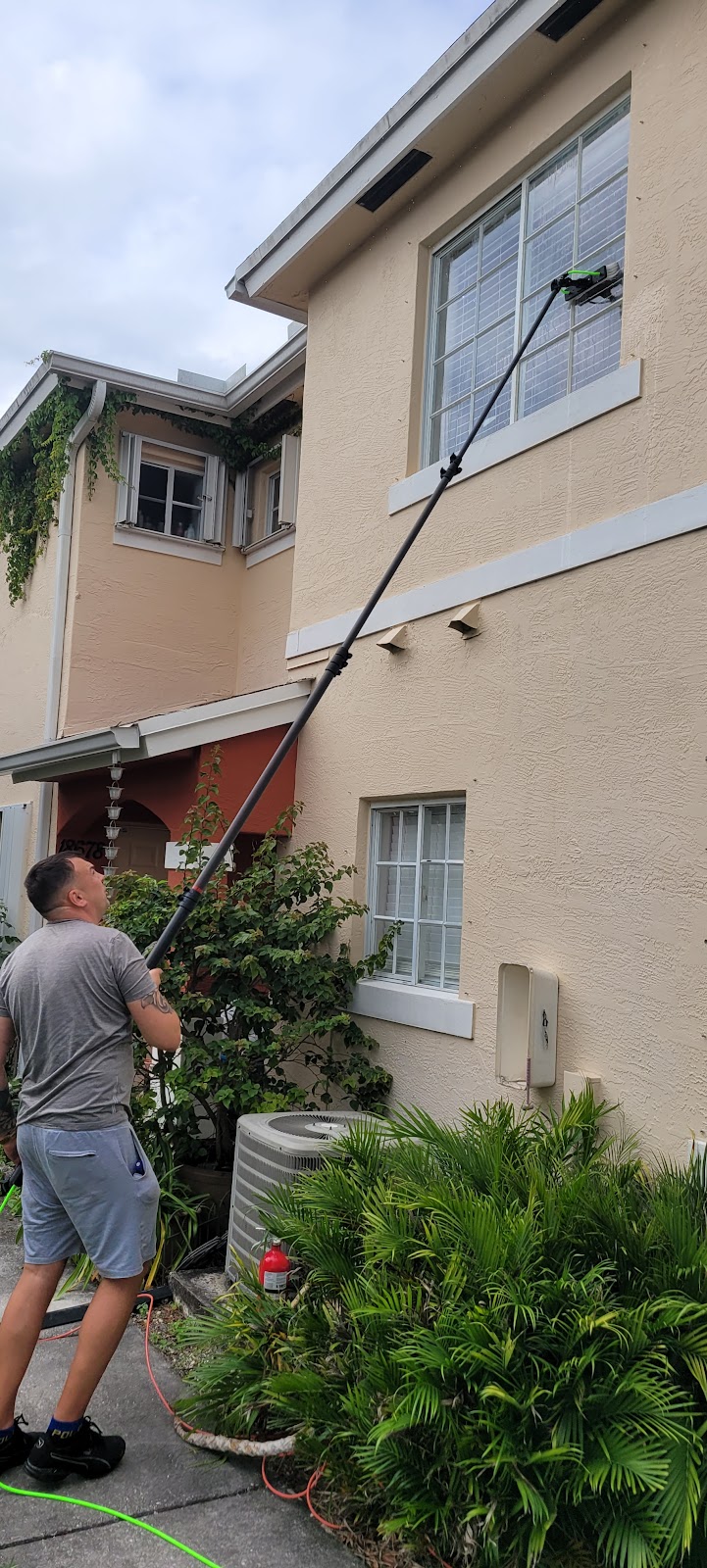
Salt spray settles on windows and dries into a mineral film that ordinary rinsing won't touch. Left long enough, it etches the glass permanently. On bayfront and near-bay Grove homes, exterior glass generally wants cleaning every six to eight weeks, not once or twice a year — the coastal cadence is much tighter than it is for a house a mile inland. We use a proper glass-cleaning process, not a squeegee-and-hope pass, because Miami also has the hardest tap water among major Florida cities (roughly 11 grains per gallon off the Biscayne Aquifer), and hard water left to dry on glass leaves its own spotting on top of the salt.
Metal that streaks and rusts
Aluminum railings, wrought-iron gates, light fixtures, garage tracks, and the screen framing on pool cages all corrode faster near the bay. Salt accelerates the rust; the rust then bleeds rust-colored streaks down stucco and pavers below it. Cleaning the metal and the surfaces it's staining is part of keeping a waterfront Grove exterior looking maintained.
Screen enclosures and pool cages
Almost every Grove pool has a screen enclosure, and near the water they take a beating — salt film on the screening, algae in the shaded corners, and mildew where the canopy drips onto the frame. These need a gentle, low-pressure hand; too much force blows out screen panels and spline. It's a common, and commonly botched, Grove job.
Efflorescence: the white haze on your coral rock and pavers
Here's a Grove-specific trap. The neighborhood is full of coral rock, oolitic limestone, and paver hardscape, and on all of those you'll eventually see a chalky white haze — especially after a wet stretch or on a wall near irrigation. That haze is usually efflorescence: mineral salts migrating to the surface as water moves through the stone or concrete and evaporates.
The mistake is sealing over it. If a driveway or a limestone wall is sealed while efflorescence is still present, the haze gets locked in and the sealer can turn milky. Efflorescence has to be identified and treated first, before any sealing. We check for it as part of the walkthrough, treat it correctly, and only then talk about sealing pavers or travertine. On soft, porous stone like travertine and coral rock, this matters even more — the wrong acid or the wrong pressure ruins the surface.
A realistic maintenance cadence for the Grove
Because the canopy and the bay work on your exterior year-round, one-and-done cleaning doesn't hold in this neighborhood the way it might elsewhere. A cadence that actually fits Grove properties:
- Shaded driveways, walkways, and pool decks: every 6–12 months. Under a banyan or live oak they trend toward the shorter end because the surface never fully dries out.
- Roofs (soft wash only): every 18–24 months to stay ahead of Gloeocapsa magma streaking on slow-drying canopied roofs.
- Bayfront and near-bay glass: every 6–8 weeks in the coastal zone; roughly quarterly a few streets inland.
- House wash / stucco soft wash: annually, more often on the north side where sun never reaches.
- Gutters: at least twice a year, and always in the April–May pre-storm window before the June 1 start of hurricane season — Grove gutters clog with palm fronds and oak debris faster than almost anywhere in Miami.
For homeowners who'd rather not track all that, our recurring maintenance plans put the whole property on a schedule tuned to its exposure — the shaded surfaces on a tighter loop, the roof on a longer one — so nothing quietly slides into a stain you have to pay more to reverse.
HOAs, historic homes, and high-rise access
The Grove has more of these access-and-approval situations than most Miami neighborhoods, and they shape how a job runs:
- Historic and West Grove homes often sit in the Grove's designated historic areas, where original materials matter and there's no room for a surface that gets etched or a wall that gets pitted. We lead with soft washing and calibrated low pressure precisely because you can't replace 1920s coral rock or original stucco.
- HOAs and condo boards around CocoWalk, Grand Avenue, and the towers usually require proof of coverage before anyone touches the building. We carry liability and workers-comp insurance and provide a Certificate of Insurance (COI) on request — the document boards ask for first.
- High-rise and multi-unit exteriors need the right equipment for elevated and multi-story work plus that same coverage. We scope the building with the board or manager rather than guessing, so access, water source, and timing are settled before the crew arrives.
What "no damage, no streaks, no shortcuts" means on a Grove job
Because so many Grove surfaces are soft, old, or expensive to replace, the guarantees matter here more than the sales pitch:
- Plant-safe soft-wash chemistry. The canopy and landscaping are the reason people live in the Grove. Our soft-wash solutions are chosen to clean the surface without cooking the ferns, orchids, and mature plantings underneath — which is unavoidable when a job is done right under this much foliage.
- Before-and-after photos. On shaded, textured surfaces it can be genuinely hard to see the difference from the street. We document it so you can.
- A 48-hour re-wash guarantee. Under heavy canopy, a stray leaf drop or a spot that needed a second pass can show up after we leave. If something isn't right within 48 hours, we come back.
Whether you're on a coral rock lane in the West Grove, a bayfront estate off Main Highway, or a condo balcony above CocoWalk, the method changes but the standard doesn't. Send a few photos or call Moppey Spottless Clean Pros at +1 877-754-5614 for a free quote — most are answered the same day, and hablamos Español.