In-depth guide
Roof Cleaning in Miami: the complete guide
The complete guide to roof cleaning in Miami
A roof in Miami works harder than almost any other surface on your property. It takes the full weight of the sun, the daily summer downpours, the salt drifting in off Biscayne Bay, and a climate that keeps organic growth alive year-round. So when it starts to darken, streak, or grow patches of green and black, it isn't cosmetic bad luck — it's the predictable result of living in one of the most aggressive roof-growth environments in the country. This guide goes past the basics and into how professional roof cleaning actually works here, what separates a good job from a damaging one, and how to keep the result you paid for.
What roof cleaning really is (and what it is not)
Roof cleaning is the controlled removal of living organisms and their staining from the roof surface using chemistry, not force. That distinction matters more on a roof than on any other surface Moppey touches. The correct method is a soft wash: a low-pressure application — well under 500 PSI, often barely more than a garden hose — of a cleaning solution that kills algae, mold, lichen, and moss at the root, followed by a controlled rinse or a dwell-and-let-nature-rinse finish depending on the roof.
It is not pressure washing. A pressure washer aimed at a roof does three destructive things at once:
- It blasts the ceramic granules off asphalt shingles — the granules are the shingle's UV shield and fire rating, and once they're in your gutters the shingle ages fast.
- It cracks, chips, and unseats tile, and forces water up under the courses where it has no business being.
- It voids most shingle manufacturer warranties the moment high pressure touches the surface.
Every major roofing manufacturer specifies low-pressure chemical cleaning for algae removal. Soft washing isn't the gentle-but-inferior option — for a roof, it is the only correct option.
The Miami problem, in detail
The black streaks bleeding down your roof are Gloeocapsa magma, a blue-green cyanobacteria. It doesn't sit on the roof; it feeds on the limestone (calcium carbonate) filler baked into asphalt shingles. Southeast Florida sits in the highest-density algae zone in the United States, and Miami hands the organism everything it wants: relentless heat, humidity that rarely drops, and daily wet-dry cycles through the rainy season. That's why streaks always start on the north- and shade-facing slopes and in valleys — the spots that dry last.
But Gloeocapsa is only the headline. Miami roofs also grow:
- Lichen — a tougher, crusty algae-and-fungus symbiote that anchors into the surface and needs a stronger dwell time and sometimes a second pass. It looks like flat gray-green or orange spots that don't rinse.
- Moss — the green three-dimensional carpet that shows up on the shadiest, dampest slopes and, unlike algae, physically holds water against the roof.
- General mildew and organic film on flat, metal, and low-slope roofs.
Layered on top is the coastal factor. Homes near the water live in a salt-laden ISO C5-M corrosion environment, which accelerates rust bleed on metal roofs, fasteners, and flashing, and leaves a salt film that keeps surfaces damp. A roof cleaning near the coast is often removing salt residue and rust staining alongside the biological growth.
What the process actually looks like
A professional soft wash follows a sequence, and the sequence is where safety and results live:
- Inspection. A crew identifies what is actually growing — algae, lichen, moss, or a mix — because each has a different dwell time and rinse approach. This is also when loose tile, cracked shingles, exposed nail heads, and clogged valleys get flagged.
- Protection. Everything below the roof is pre-wetted and shielded: plant beds, shrubs, hedges, the pool, hardscape, and painted surfaces. Miami landscaping is expensive, and the cleaning solution has to be neutralized around it, not sprayed over it.
- Application. The solution — a measured mix built around sodium hypochlorite with a surfactant to help it cling and penetrate — is applied at low pressure and given time to dwell. Dwell time is the active ingredient; rushing it is what leaves streaks behind or forces someone to add pressure they shouldn't.
- Kill and rinse. The growth dies at the root. Depending on the roof material and pitch, the crew either rinses gently or lets the next rain complete the rinse. Because the organism is dead, the roof keeps clearing over the following days rather than needing to be scoured now.
- Cleanup. Landscaping gets a final rinse-down so nothing dries with solution on it, and gutters get checked for the palm-frond packing that's so common here.
How each roof material is handled
Miami has more roof variety than most markets, and the right method changes with the material:
- Asphalt shingle — the classic Gloeocapsa canvas. Pure soft wash, no exceptions, so the granules stay on the roof and the warranty stays intact.
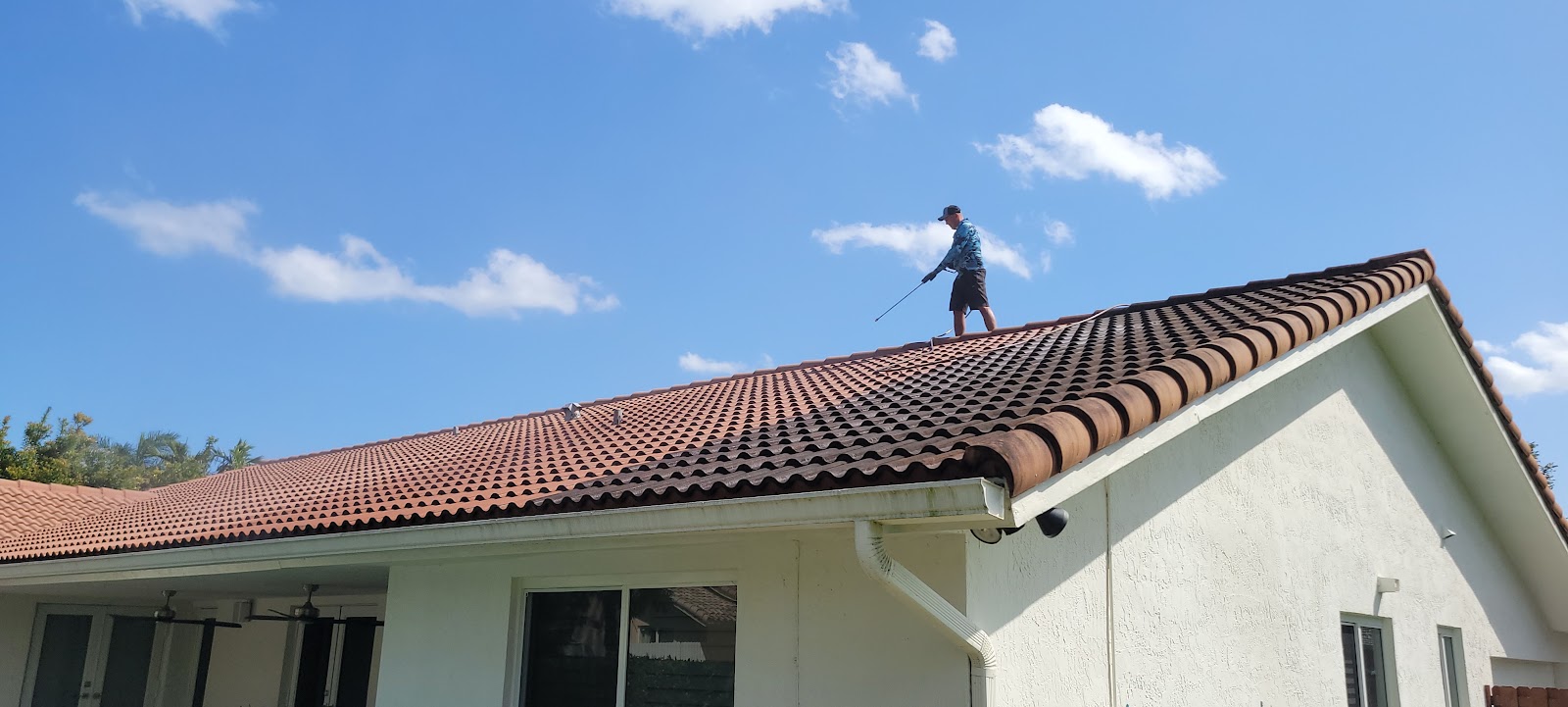
- Barrel and clay tile — the signature South Florida look. Tile is brittle and the underlayment is what actually keeps water out, so foot traffic is minimized and pressure is off the table. Chemistry does the work while the crew works from edges and roof-safe access where possible.
- Concrete flat tile — porous, so growth roots deeper; it takes a thorough soak and often benefits from a maintenance rhythm.
- Metal and standing-seam — mildew and salt-driven rust bleed dominate near the coast. Low pressure only, and treatment tuned to lift organic film without stripping factory coatings.
- Flat, low-slope, TPO, and modified-bitumen (common on commercial and modern builds) — pooling and mildew are the issues; the wash is calibrated so the membrane isn't degraded.
What drives the cost
Moppey quotes every roof after seeing it, and there's no honest way to price one from a web form. The real factors are:
- Size and pitch — square footage and how steep and complex the roof is (valleys, dormers, multiple planes all add time and access difficulty).
- Material — tile and metal need more careful handling than a simple shingle slope.
- Condition and growth type — a light algae haze is a different job than embedded lichen and moss that need extra dwell and a second pass.
- Height and access — two-story and high-rise work requires proper fall protection, equipment, and the liability and workers-comp coverage behind it.
- Landscaping and surroundings — dense, delicate plantings mean more protection and rinse-down time.
You'll get a transparent free quote with no hidden fees rather than a made-up number, and most requests get a same-day reply.
How often, and how to make it last
Most Miami roofs benefit from a soft wash every couple of years, sooner if the roof is heavily shaded, north-facing, or under tree cover where growth returns fastest. The smartest window is April or May — the tail of the dry season, before the June 1 start of hurricane season — so the roof heads into storm season clean and shedding water instead of holding it.
To stretch results:
- Keep trees trimmed back off the roof so slopes get sun and dry out.
- Keep gutters clear — clogged, palm-frond-packed gutters back moisture up onto the roof edge and feed growth.
- Consider zinc or copper strips near the ridge. As rain washes over them, trace metal ions inhibit algae downslope — a genuine preventive, not a gimmick.
- Get on a recurring maintenance plan so a light touch-up wash keeps the roof from ever re-blackening, which is far cheaper and gentler than letting it fully regrow.
Roof cleaning vs. the alternatives
Homeowners often weigh cleaning against two other options. Against DIY or a rental machine, the math is lopsided: a ladder on a wet Miami roof is genuinely dangerous, a pressure washer will strip granules and void your warranty, and store-bought cleaners rarely have the right chemistry or dwell strategy to kill growth at the root — so it comes back in months. Against roof replacement, cleaning is the reason many roofs don't need replacing yet. Unchecked algae and moss trap heat and moisture and can cut a 20-to-25-year roof down to 12-to-15. A soft wash that stops the biological clock can add years to a roof for a fraction of replacement cost.
Signs you need a roof cleaning
- Dark vertical streaks running down shingle slopes (classic Gloeocapsa).
- Flat gray, green, or orange crusty spots that don't rinse off — lichen.
- Green three-dimensional carpet on shaded slopes — moss holding water against the roof.
- Rust bleed and staining on or below metal roofs, flashing, or fasteners near the coast.
- A cooling bill creeping up as the darkened surface soaks in more heat.
- You're listing the home, and the roof photographs older than it is.
Why a careful professional beats a rental machine
Roof cleaning rewards judgment over horsepower. The difference between a roof that comes back clean for years and one that's damaged, streaked, or unsafe is knowing which organism you're killing, how long to let the solution dwell, how to protect the landscape below, and how to move on tile without cracking it — all while working safely at height with the right insurance behind the crew. That's the right method for the surface: no high pressure, no stripped granules, no voided warranty, no shortcuts. Moppey soft washes Miami roofs with plant-safe protection, before-and-after photos, a COI available on request, and a 48-hour re-wash guarantee.
If your roof is telling on you, get a straight answer and a free quote. Call Moppey Spottless Clean Pros at +1 877-754-5614. Hablamos Espanol.