
Local guide
Exterior cleaning in Hialeah: the complete guide
Why Hialeah Surfaces Get Dirty Faster Than the Sales Brochure Admits
Hialeah sits inland, tucked against the Miami River and the Palmetto, with no ocean breeze to dry things out and no bay to pull humidity off the streets. That geography matters more than most people realize. Coastal Miami gets salt problems; Hialeah gets a stagnant-air, high-humidity problem. Warm damp air settles between the closely spaced homes off Palm Avenue, West 4th Avenue, and the numbered streets north of Okeechobee Road, and it stays there. Surfaces that never fully dry are surfaces that grow algae, and that is the single biggest reason a Hialeah driveway, roof, or stucco wall looks tired years before it should.
The city's building stock compounds it. Most of Hialeah went up between the 1950s and the 1970s as affordable concrete-block-and-stucco housing for a fast-growing working population, and a huge share of it is duplexes, triplexes, and small multi-family lots rather than single-family homes. That means shared driveways, shared walls, back-to-back carports, and a lot of low-slope flat roofing that traps water and organic debris. It also means older paint and older sealer than you'll find in newer suburbs like Doral or Miami Lakes next door. Old finishes hold dirt. That is not a flaw in your property; it is just what a 60-year-old stucco wall in a humid inland city does.
The Surfaces That Actually Need Attention in Hialeah
Rather than list every service, it helps to think about which exterior surfaces in a typical Hialeah property carry the most risk if they're ignored.
- Flat and low-slope roofs. Hialeah has far more flat and low-slope roofing than the barrel-tile-heavy villages to the south. Flat roofs pond water, and standing water plus Miami humidity is a greenhouse for algae and mildew. These need a gentle soft wash, never a pressure wand, because the coating and membrane on a flat roof damage easily and any lifted seam becomes a leak.
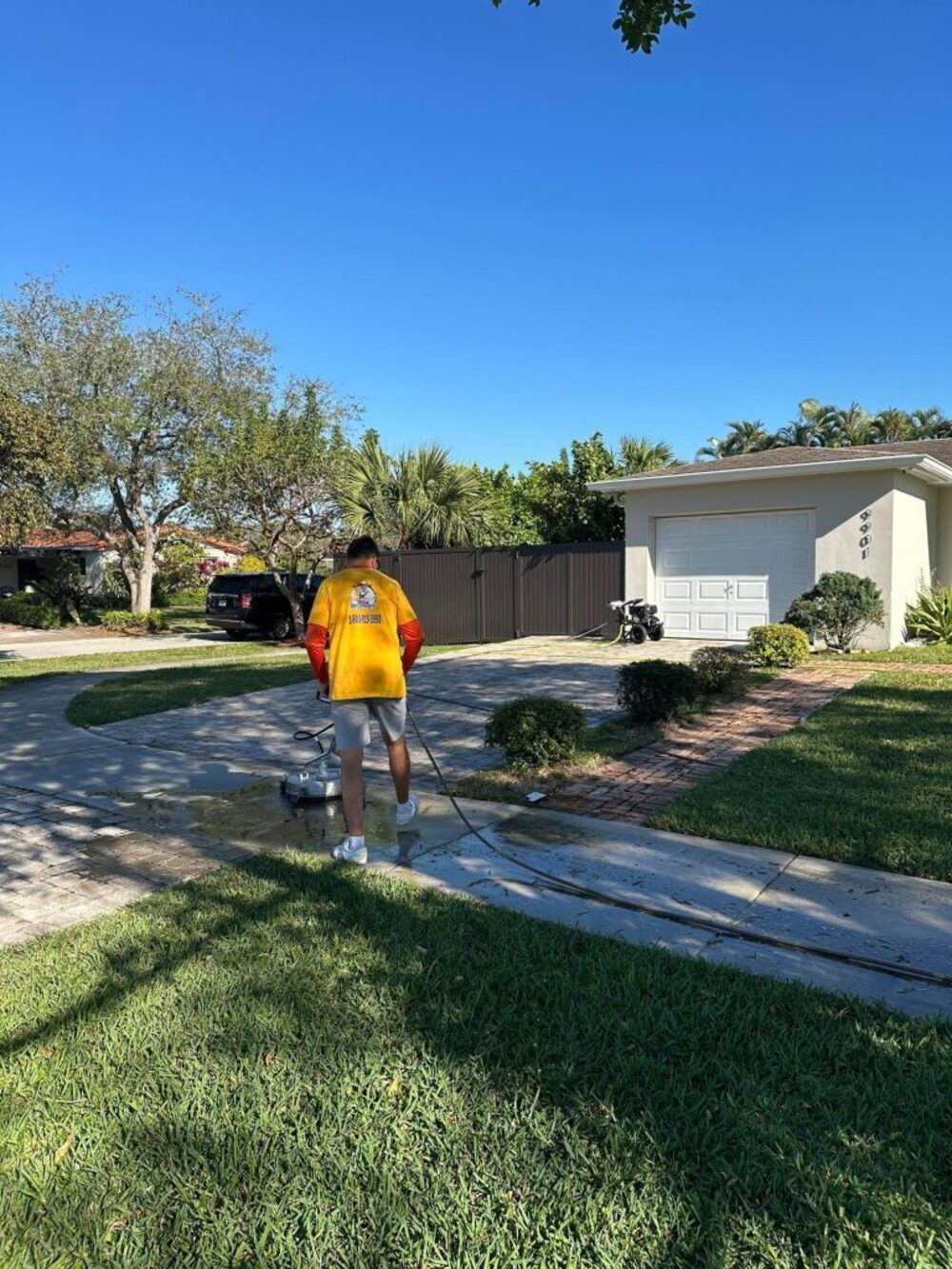
- Carports and shared driveways. The carport is the Hialeah signature. Decades of cars dripping oil and rust onto a shared or narrow slab leaves the kind of staining that ordinary rinsing never touches. Concrete can take real pressure, so this is where controlled pressure washing with a surface cleaner earns its keep.
- Stucco between the houses. On tight lots, the wall facing the neighbor rarely sees direct sun. That shaded, damp face is where mold and algae take hold first. It gets soft washed under 500 PSI, because pressure etches an aging stucco finish and leaves permanent wand marks.
- Screened patios and Florida rooms. Almost every older Hialeah house has a screened back slab or Florida room. Screen mesh, aluminum framing, and the slab underneath collect a slick green film that makes the whole space unusable. This is a soft-wash job, not a blast.
- Perimeter fences and CBS walls. Chain-link and painted block walls line most Hialeah lots. They streak with dirt and mildew and are usually the first thing a visitor sees.
Coral Rock, Efflorescence, and the Old-Hialeah Details
Not everything here is plain block and stucco. Older blocks near Hialeah Park and the original 1920s-era Curtiss-built neighborhoods hold keystone and coral-rock accents, decorative planters, and low ornamental walls. That porous stone stains deeply and cannot be pressure-blasted; it needs a low-pressure treatment and patience. On newer paver work and any painted or sealed masonry, watch for a chalky white haze called efflorescence — mineral salts pushing to the surface as the concrete cures and dries. It looks like a cleaning failure, but scrubbing harder makes it worse. Efflorescence has to be identified and treated correctly, and any sealing has to wait until it's resolved, or you seal the haze in permanently.
The Commercial and Industrial Side of Hialeah
Hialeah isn't just houses. It's one of the densest light-industrial zones in Miami-Dade — the warehouse district off Okeechobee Road, the loading bays around East 10th Avenue, the truck yards, and the retail corridors around Westland Mall and the Palm Springs Mile. Commercial exterior cleaning here is a different animal from a home wash. Loading aprons take diesel drips and forklift traffic. Dumpster pads grow bacteria and odor that a code inspector notices. Storefront entrances along West 49th Street move enough foot traffic that a stained walkway reads as a neglected business. For any of this, the equipment and the coverage matter — proper reclaim where runoff into storm drains is regulated, and real liability and workers-comp coverage before a property manager will let a crew on site. Moppey comes equipped and insured for both the residential blocks and the industrial bays, and can schedule around business hours so a wet walkway never sits in front of your customers.
How Often Hialeah Properties Actually Need It
Because Hialeah traps humidity, the honest cadence is a little more frequent than the "once every 12 to 18 months" you'll see on a generic Miami page. Here's a realistic rhythm:
- Driveways, carports, and walkways: once a year for most homes, twice a year on shaded lots or shared slabs that stay damp.
- Roof soft wash: every 2 to 3 years for tile, sooner for flat roofs that pond or sit under a tree.
- Stucco house wash: every 12 to 18 months; the shaded side often greens up first and can be spot-treated between full washes.
- Screened patios and Florida rooms: annually, before you actually want to use the space in the dry season.
- Commercial entrances and pads: quarterly to monthly depending on traffic and code requirements.
This is exactly where a recurring maintenance plan pays off. Instead of waiting until the algae is thick and the stains are set, a scheduled light wash keeps growth from ever establishing — which is cheaper, faster, and far kinder to old finishes than a heavy annual reclaim.
Hurricane Season Is an Inland Problem Too
People assume storm prep is a coastal concern, but Hialeah's real risk is drainage. The city sits low and inland, its canals and the Miami River back up in heavy rain, and street flooding is a recurring reality in the older sections. A clogged gutter on a Hialeah house doesn't just overflow — it sends water straight down against a foundation that's already dealing with a high water table. Palm fronds, mango leaves, and roof debris pack gutters and low-slope drains fast here. The smart window to get roofs cleaned and gutters cleared is April and May, before the June 1 start of hurricane season, so a clean roof sheds water and the drainage paths are open when the summer storms arrive. Clean the flat roof, clear the scuppers and downspouts, and you've removed two of the most common ways a Hialeah home takes on water damage in a wet season.
The Miami Water Problem, Up Close
One last local reality worth naming: Miami-Dade, including Hialeah, draws from the limestone Biscayne Aquifer and runs some of the hardest water of any major Florida city, around 11 grains per gallon. Every time your sprinklers overspray the windows or a summer rain dries on the glass, that calcium and magnesium bakes into white spotting that ordinary soap and water will not remove. Glass, screen frames, and car-adjacent surfaces around carports show it worst. Clearing it takes a proper mineral treatment, not more scrubbing — and once it's clear, a maintenance rhythm keeps it from re-etching the glass.
That is the whole philosophy behind how Moppey works in Hialeah: the right method for the surface, every time. Soft washing where pressure would damage old stucco, tile, and flat roofs. Controlled pressure where concrete and pavers can take it. Honest advice about which stains lift completely and which only lighten. No damage, no streaks, no shortcuts — just a Hialeah property that looks cared for. For a free quote on your home, duplex, or business, call Moppey at +1 877-754-5614. Most quotes come back the same day, and hablamos Español.