
Local guide
Exterior cleaning in Doral: the complete guide
A Doral maintenance guide, block by block
Doral packs more surface variety into its square mileage than almost anywhere else in Miami-Dade. Master-planned single-family communities sit a few minutes from one of the densest industrial corridors in Florida, and between them a whole vertical Downtown Doral has gone up in the last fifteen years — mid-rise and high-rise condos, wrapped townhomes, ground-floor retail, and glass-heavy modern facades. Each of those needs a different exterior-cleaning plan. This guide goes past the basics and into how the work actually gets scheduled, sequenced, and priced-by-factors across the different parts of the city.
Match the plan to the community, not just the surface
The gated communities west and north of Downtown were mostly built in the boom years around 1998 to 2007, and they share a construction recipe: stucco elevations, barrel or flat concrete tile roofs, brick-paver driveways, screened pool cages, and lots that were carved around man-made lakes. But how fast they dirty depends heavily on the specific lot.
- Lakefront and fairway lots (much of Doral Isles, Islands of Doral, Doral Park Country Club frontage): constant ground humidity means the shaded elevation — usually the north or east wall — greens up first and needs attention roughly twice as often as a dry interior lot. These homes often benefit from a house-wash and roof soft-wash on the same visit so the whole envelope resets at once.
- Interior single-family lots in Doral Estates, Vintage Estates, and the older Costa Del Sol / Doral Park streets: drier, but the mature landscaping throws shade and drops organic debris, so pavers and the pool deck are usually the first complaint.
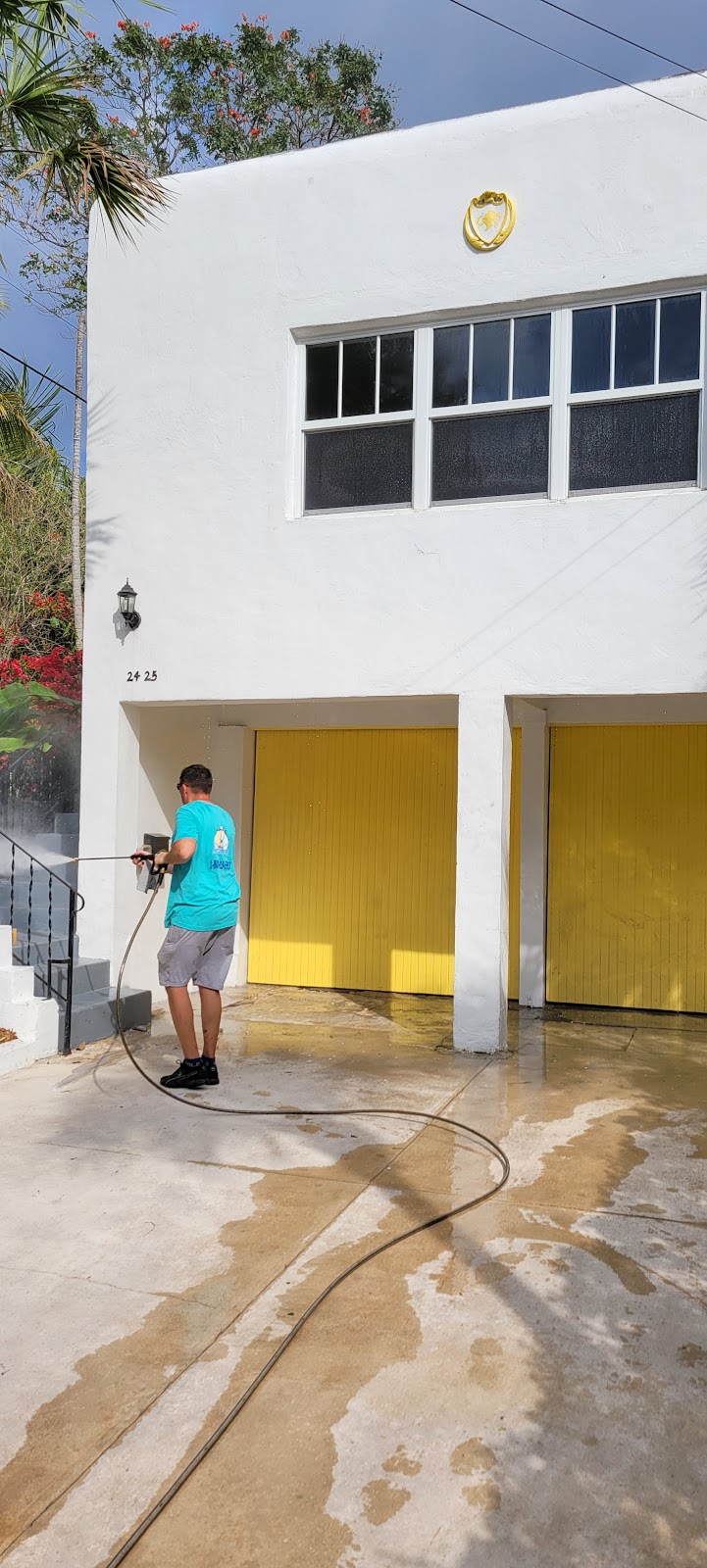
- Townhome and villa clusters (Islands of Doral townhomes, Grand Bay, Terracina): shared walls and tight setbacks mean access matters. We coordinate so one crew clears a row of units efficiently, which is also how HOAs prefer it billed.
Downtown Doral: high-rise glass, garages, and HOA access
Newer Doral — the Downtown Doral district, CityPlace, Modern Doral, and the mid-rise condos along NW 53rd Street and around the Doral Legacy area — is a different animal. These are contemporary buildings with large glass facades, aluminum and composite cladding, elevated balconies, and structured parking. The cleaning priorities shift:
- Glass and balcony rails carry hard-water spotting and, on higher floors catching wind off the Everglades edge and the coast, a fine airborne film. Modern impact glass shows every spot, so it wants a treated clean, not a garden-hose rinse. Exposed upper-floor glass on these buildings generally holds up best on a six-to-eight-week cycle.
- Balcony deck and railing washing for individual condo owners is common, and it has to be done with containment so runoff doesn't sheet onto the unit below — high-rise work is as much about controlled water and drop cloths as it is about pressure.
- Parking-structure aprons, entry drives, and pool-deck amenity levels are the shared-surface jobs that HOA and property-management boards schedule. These need proper liability coverage and, on multi-story access, the right lift or reach equipment. We carry insurance and provide a certificate of insurance on request, which is usually the first thing a management company asks for.
If you sit on an association board or manage a Downtown Doral tower, the practical move is a written scope covering building faces, glass, amenity decks, garage entries, and walkways on a recurring cadence, so nobody is chasing a vendor after every rainy season.
The Airport West industrial corridor: exterior cleaning as facility maintenance
Doral's warehouse belt — the tilt-wall distribution centers and flex buildings packed around Miami International Airport, along NW 25th Street, NW 87th and 107th Avenues, and out toward the Palmetto and Turnpike interchanges — treats exterior cleaning as scheduled facility upkeep, not a one-off. The wear pattern is specific: diesel soot and brake dust settle on the street-facing tilt-wall, tire scuff and hydraulic-fluid marks build up across loading-dock aprons, and algae climbs the shaded rear and side elevations that never see direct sun. Add the constant fine dust kicked up by trucking lanes and you get a building that reads dingy within a year even when the tenant does nothing wrong.
For these properties we structure the work the way property managers actually budget it — quarterly or semi-annual, with the building faces, dock aprons, dumpster pads, sidewalks, and parking handled on one mobilization. Storefront and showroom-office units on the front of a flex building often want their glass on a tighter cycle than the rest of the structure. A clean, consistently maintained exterior is also a leasing asset: prospective tenants read a stained loading apron as deferred maintenance on the whole facility.
Travertine, efflorescence, and the right order of operations
A lot of Doral pool decks and entry landings are travertine or a soft coping stone, and a lot of paver and stone surfaces here throw a white, chalky haze — that is efflorescence, mineral salts wicking up through the stone and drying on the surface. Two things people get wrong: they blast travertine at concrete pressure and pit it permanently, and they seal over efflorescence and lock the haze in for good. The correct sequence is to clean at calibrated pressure, treat and clear the efflorescence, let the surface fully dry, and only then reseal. Sealing traps whatever is underneath, so it has to come last, done right. This matters especially on the lakefront lots where the stone stays damp and the salts keep migrating.
Miami water, coastal air, and how often Doral surfaces really need it
Doral runs on the Biscayne Aquifer like the rest of Miami-Dade, which means the hardest tap water of any major Florida city — roughly 11 grains per gallon. That mineral load is why glass, screen enclosures, and car-wash-adjacent surfaces spot so fast, and why a plain rinse never fully clears it. Doral sits inland enough that it dodges the worst direct salt spray of the barrier islands, but coastal air still reaches it, so metal railings, screen frames, and awnings still see accelerated filming and corrosion compared to a truly landlocked town.
A workable Doral cadence looks roughly like this: house-wash and roof soft-wash every 12 to 24 months depending on lot exposure (shorter on lakefront and shaded lots), driveway and paver cleaning annually with re-sanding and sealing as needed, pool deck and screen enclosure yearly or when it starts feeling slick underfoot, and glass every couple of months residentially — tighter on high-exposure Downtown Doral floors.
Time the big jobs around hurricane season
South Florida's hurricane season runs June 1 through November 30, and Doral's flat, low-lying, canal-and-lake-laced geography makes drainage a real concern. The smart pre-storm window is April and May. Two jobs matter most before the season turns: a roof soft-wash so the tile or shingle sheds water cleanly instead of holding it under a mat of algae, and a gutter clear-out — Doral's mature palms drop fronds and seed debris that clog gutters and downspouts, and a clogged system overflows toward the foundation exactly when the heaviest rain arrives. Getting both done in spring means the property is set before the first named storm.
Across all of it — Doral Isles house-washes, Downtown Doral high-rise glass, Airport West warehouse exteriors, and everything between — the rule doesn't change: the right method for the surface, no damage, no streaks, no shortcuts. For a free quote on any exterior surface in Doral, call Moppey at +1 877-754-5614. Most quotes are answered the same day, and hablamos Español.