In-depth guide
Storefront & Facade Cleaning in Miami: the complete guide
Storefront and facade cleaning in Miami: the complete guide
A storefront is the only marketing you can't turn off. It works on every person who drives, walks, or scrolls past — and in Miami's climate, it degrades faster than anywhere else in Florida. Salt bonds to glass. Humidity feeds mildew on stucco. Afternoon rain leaves mineral spots. Foot traffic grinds gum and grease into the entry concrete. Left alone, the whole street-facing package slides at once, and a business that opened looking sharp reads "neglected" by mid-summer. This guide goes past the basics and into the surface-by-surface craft, the frequency math, and the Miami-specific decisions that separate a facade clean that lasts from one that streaks back in a month.
What storefront and facade cleaning actually covers
The term sounds like one job. It's really a coordinated sequence across surfaces that each demand a different tool, pressure, and chemistry. A proper storefront clean handles:
- Entrance glass, sidelights, and glass doors — hand-washed and squeegeed, or given a purified-water rinse where mineral spotting is heavy
- The facade above street level — stucco, EIFS, brick, split-face block, metal panels, or composite cladding, soft washed to kill mold and algae at the root
- Signage, channel letters, and light boxes — cleaned by hand or at gentle pressure so faces don't crack and fixtures don't flood
- Awnings and canopies — soft washed so fabric and vinyl don't tear or fade
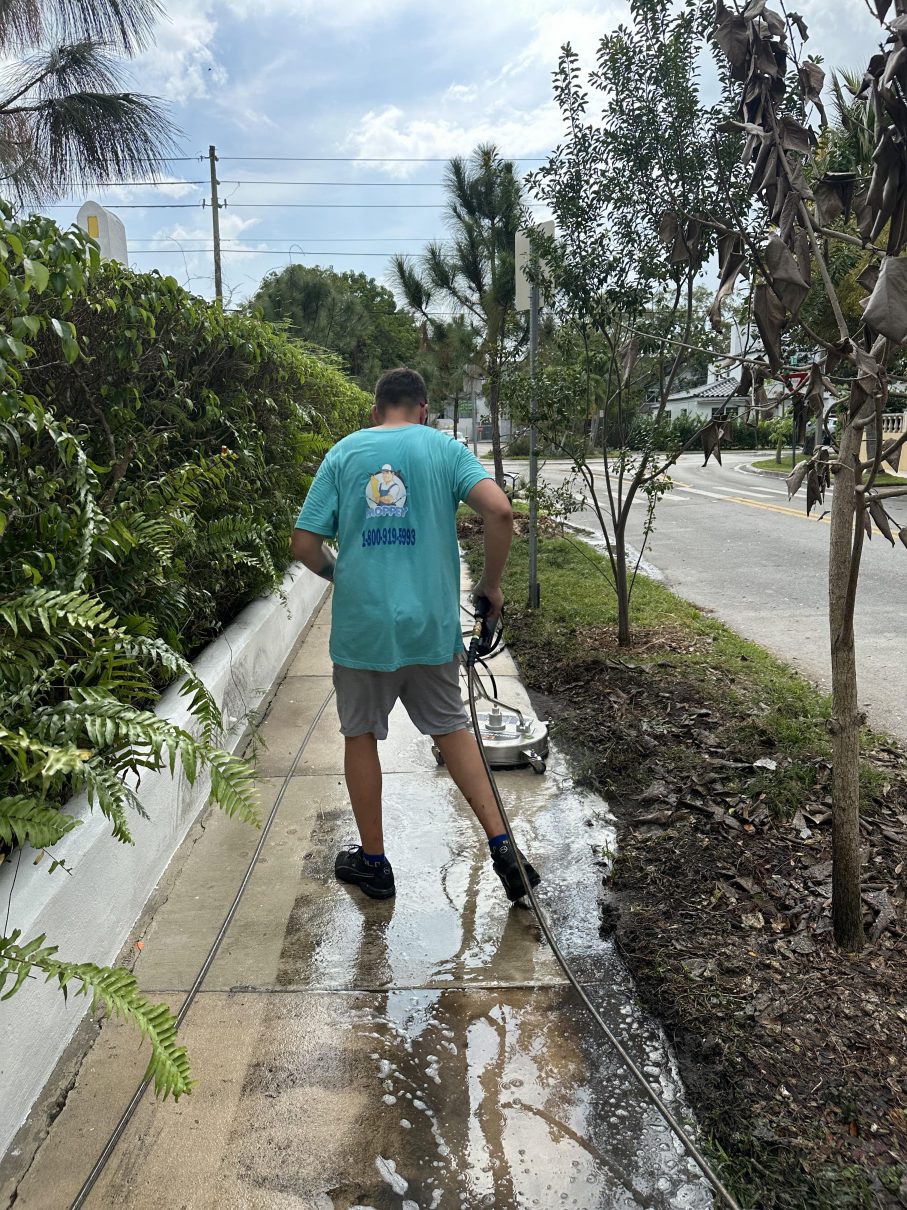
- The entry sidewalk, walkway, and pad — full-pressure surface cleaning to lift gum, grease, and foot-traffic film
- High-touch hardware — door pulls, push plates, kick plates, and thresholds detailed so the whole entrance reads finished
The mistake that wrecks storefronts is treating that list as one blast target. High pressure on stucco etches it and drives water behind the wall; on an awning it shreds the fabric; on a sign face it cracks the acrylic; on glass it can chip the edges and blow out the perimeter seal. The right method for each surface is the entire job.
The Miami problems this service is built to solve
Every Miami facade fights three forces the rest of the country doesn't face at this intensity:
- Salt corrosion (coastal ISO C5-M). Frontages within roughly a kilometer of the coast or Biscayne Bay sit in the most aggressive corrosion category the international standard defines. Airborne salt bonds to entrance glass as a haze that re-coats within weeks, and it slowly pits and rusts metal door frames, sign cabinets, awning hardware, and railings.
- Humidity-driven biological growth. Year-round moisture and daily summer rain feed mold, mildew, and algae on stucco, EIFS, and awnings. The green and black streaking you see isn't dirt sitting on the surface — it's a living colony rooted into the pores, which is why wiping or blasting only makes it come back faster.
- The hardest water among major Florida cities. Miami tap water runs around 11 grains per gallon, drawn from the limestone Biscayne Aquifer. Every sprinkler drift, hose splash, or rain sheet that dries on glass leaves a dense calcium-magnesium spot that ordinary washing can't clear.
Add ground-level realities — gum, spilled drinks, grease tracked from restaurants, and gray foot-traffic film on the entry concrete — and you have a facade that needs a genuine maintenance discipline, not an annual scrub.
How the process works, step by step
A professional storefront clean follows a top-down, dirty-to-clean sequence so nothing already cleaned gets re-soiled:
- Walk and scope. The frontage is sorted by surface — what takes pressure, what needs soft washing, what gets hand detail — and access, water source, and drainage are confirmed. Water containment away from the doorway and public walkway is planned here.
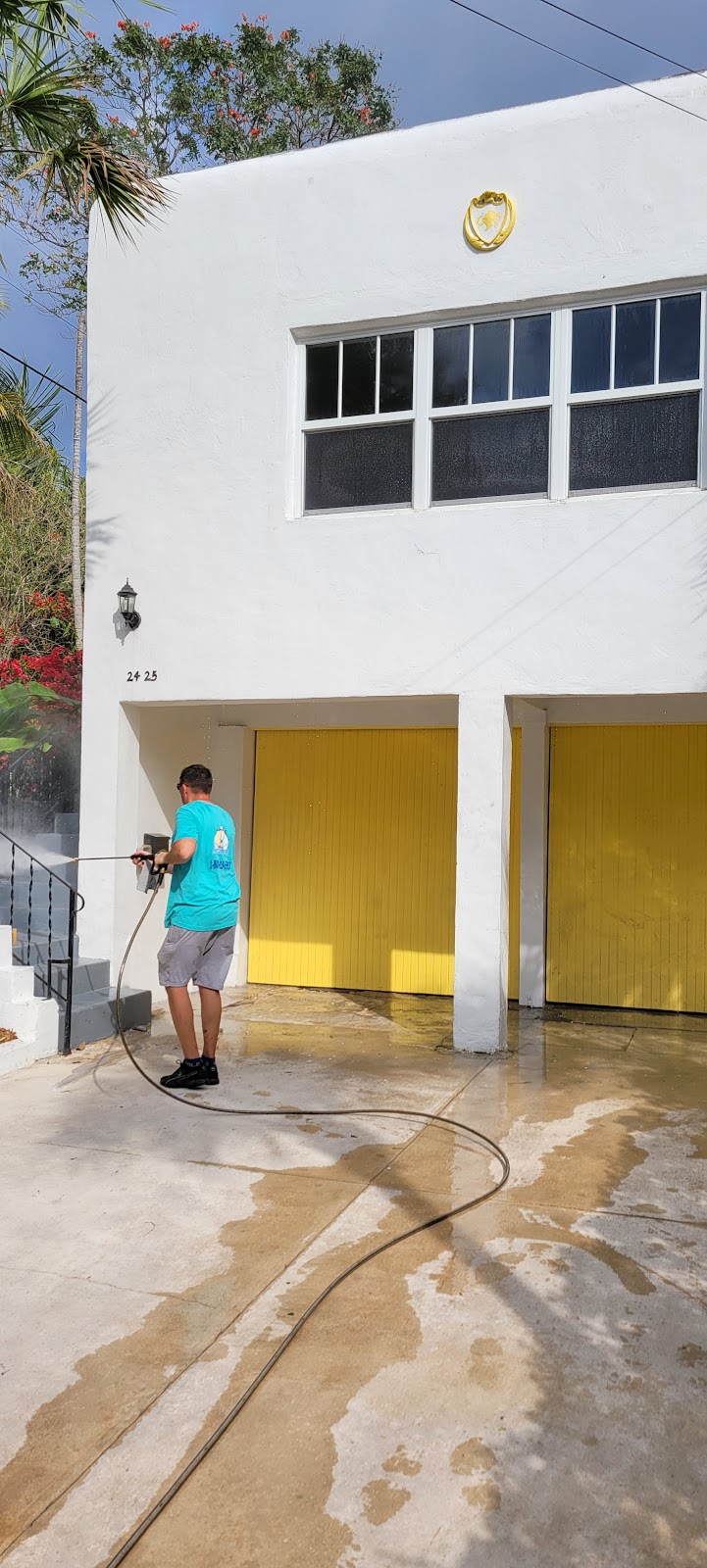
- Facade first. Stucco, EIFS, brick, and panels get a low-pressure soft wash with a solution matched to the growth. The chemistry kills the algae and mildew colony; the wall is then rinsed clean, not blasted.
- Signage and awnings. Channel letters and light boxes are cleaned by hand or at gentle pressure. Awnings and canopies are soft washed so the fabric releases its black streaking without tearing.
- Glass and touchpoints. Entrance glass, sidelights, and doors are hand-washed and squeegeed, with a purified-water rinse where hard-water or salt spotting demands it. Door pulls, push plates, and thresholds are wiped down.
- The ground last. A rotary surface cleaner runs real pressure across the sidewalk and entry pad, lifting gum, grease, and traffic film in an even pass with no wand stripes across the entrance.
- Full rinse-down. The entire frontage is rinsed so nothing dries with a dirty film, and debris is cleared from the doorway before the doors open.
Surfaces and materials, and how each is treated
The reason experience matters is that every facade material fails differently under the wrong approach:
- Stucco and EIFS are porous and, in the case of EIFS, foam-backed. They must be soft washed under low pressure; high PSI etches the finish and can force water into the wall system, where it causes real structural damage.
- Brick and split-face block hold algae deep in their texture and mortar joints. Chemistry does the work; aggressive pressure erodes soft mortar and pits the face.
- Metal and composite panels (ACM, aluminum, storefront framing) show streaking and salt film. They clean with gentle pressure and the right detergent; abrasive methods scratch the finish and accelerate coastal corrosion.
- Glass near the coast carries a salt haze that needs the correct solution, not muscle; inland glass carries hard-water mineral spots that often require a targeted acid or specialty treatment because the deposit is bonded, not loose.
- Awning fabric and vinyl fade and tear under pressure and hold mildew in the weave — a soft-wash-only surface, always.
- Concrete entry pads are the one durable surface that earns full pressure, cleaned with a surface cleaner for an even, stripe-free finish.
Restaurants, grease, and health-code frontages
Restaurant and food-service storefronts carry a load retail doesn't: airborne grease that settles on the facade, grease tracked onto the entry concrete, dumpster-pad and back-of-house buildup, and health-inspection exposure. Greasy concrete near an entrance isn't just ugly — it's a slip hazard and an inspection flag. Degreasing agents and hot-water-capable surface cleaning break down oils that cold water and plain pressure just smear around. For food-service tenants, a scheduled frontage and pad clean is part of staying inspection-ready, not just looking good.
What drives the cost
No two frontages price the same. The honest factors that move a storefront quote are:
- Frontage width and total square footage across all surfaces, not just the glass
- Which surfaces are in scope — glass only, or glass plus facade, signage, awnings, and sidewalk
- Condition and neglect level — a maintained frontage cleans fast; years of rooted algae, bonded salt haze, or ground-in gum takes more time and stronger chemistry
- Surface material — delicate EIFS, carved signage, and hard-water-etched glass need slower, more careful methods
- Access and height — upper facade, tall signage, and anything requiring lifts or ladders adds labor and equipment
- Frequency — recurring visits almost always cost less per visit than one-off calls because the surfaces never fully redevelop
We never quote a flat storefront price sight-unseen. A quick look at the frontage or a few photos and the details above get you an accurate free quote.
How often to schedule it in Miami
Frequency is where Miami businesses save the most money, because maintenance is far cheaper than restoration:
- Coastal and bay-front glass: every 6–8 weeks. Salt re-hazes fast this close to the water.
- High-traffic entryways and sidewalks: roughly quarterly, so gum and traffic film never build into a stain.
- Full facade and awning soft wash: every 6–12 months for most storefronts, tighter for shaded, north-facing, or heavily-vegetated walls that stay damp.
- Restaurants and heavy foot traffic: more frequent entry-pad cleaning, often monthly to quarterly.
Waterfront corridors and shaded facades slide faster; a maintained recurring plan holds the whole frontage at a consistent standard instead of swinging between "just cleaned" and "looks tired."
How it compares to DIY and a rental machine
A rental pressure washer is the fastest way to turn a maintenance job into a repair bill. Consumer machines have one setting — too much pressure — with no way to soft wash the facade, no purified-water system for the glass, and no surface cleaner for stripe-free concrete. The predictable results are etched stucco, torn awnings, cracked sign faces, water forced behind panels, and wand stripes across the entry. A careful professional brings the full method range — low-PSI soft washing with the right chemistry, hand-detailing and spot treatment for glass, and controlled high pressure only where concrete can take it — plus water containment, off-hours scheduling, and the insurance most landlords require before anyone works on a commercial frontage. The difference isn't effort; it's knowing which of five different approaches each surface needs.
Signs your storefront needs it now
- Entrance glass looks cloudy or hazy even right after your staff wipes it
- Green or black streaking is spreading down the stucco, panels, or awning
- The sidewalk has a dark trail where customers walk, or visible gum and grease at the door
- Door pulls and push plates look grimy and smudged by mid-morning
- Signage is dulled or filmed and reads less bright at night
- A grand opening, inspection, lease renewal, or busy season is coming up
If your frontage is checking two or more of those boxes, it's already costing you walk-ins. A clean, cared-for entrance is the cheapest customer acquisition you have.
Moppey cleans the entire street-facing package across Miami and South Florida — glass, facade, signage, awnings, and sidewalk — with the right method matched to each surface, off-hours so we never block your door, and fully insured with a COI on request. For a fast, free, no-pressure quote, call +1 877-754-5614. Most quotes answered the same day. Hablamos Español.