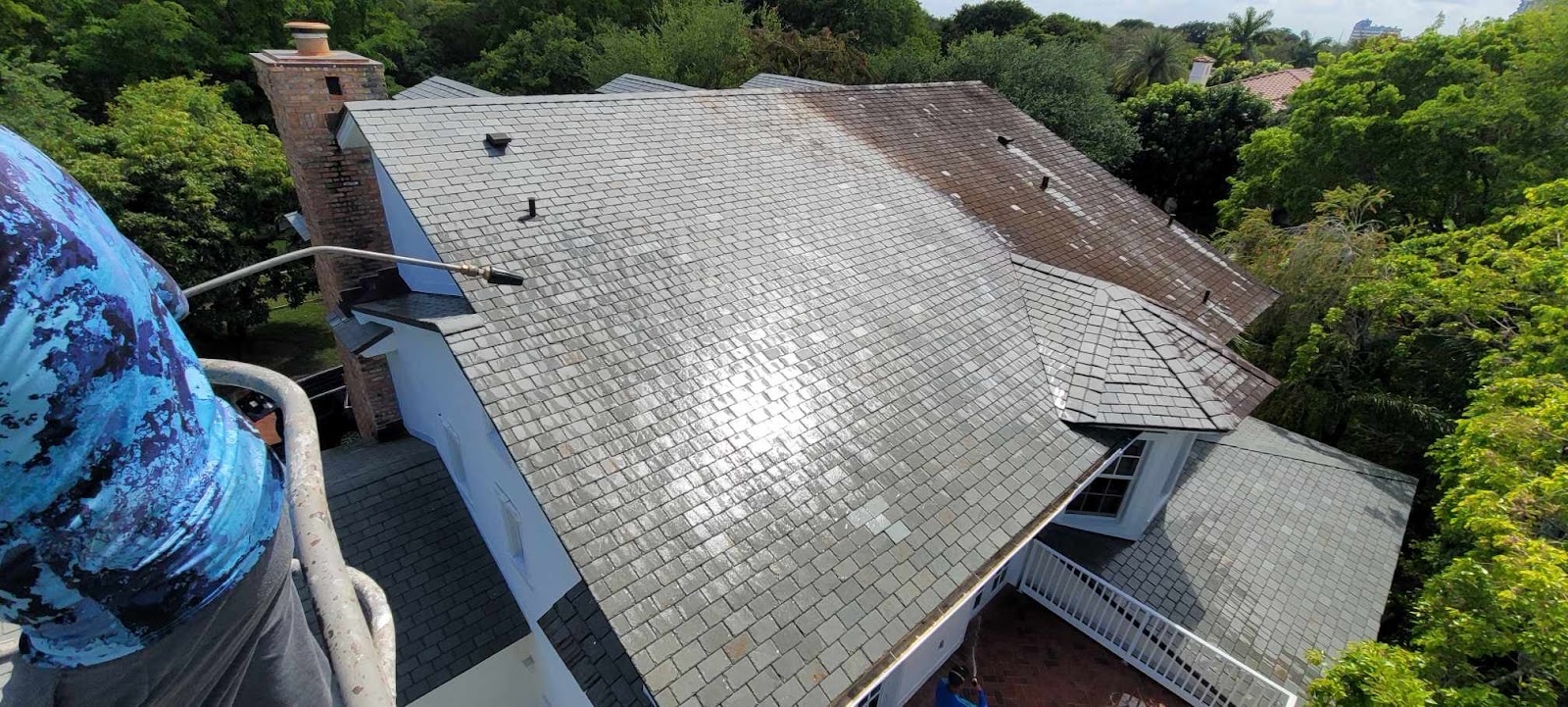
You look up at your roof one day and there they are: long dark streaks running down the shingles, usually on the north-facing slope, usually worst under trees. They look like dirt. They look like water damage. They look like your roof is simply getting old.
None of that is what's happening.
Those streaks are alive. And in a climate like Miami's, they don't go away on their own — they spread.
The real cause: a cyanobacteria called Gloeocapsa magma
The black staining on almost every streaked roof in South Florida comes from a single culprit: Gloeocapsa magma, a hardy blue-green cyanobacteria (often loosely called algae). It travels through the air as spores, lands on your roof, and takes hold wherever it can find moisture and food.
Here's the part most homeowners never hear. On asphalt shingles, that "food" is the limestone filler manufacturers mix into the shingle to add weight and fire resistance. The bacteria feed on it. As the colony grows, it produces a dark, pigmented sheath to protect itself from UV light — and that pigment is the black you see.
The streaking pattern is a giveaway. Colonies start high on the roof and get washed downward by rain, spreading in vertical stripes. That's why the stains almost always run down the slope, not across it.
Why Miami roofs are a perfect target
Very few places on earth suit this organism better than Miami. Three conditions line up almost year-round:
- Constant humidity. Gloeocapsa magma needs moisture to survive, and Miami rarely runs short of it. Morning dew alone keeps roofs damp long enough for colonies to thrive.
- Heat and a long growing season. There's no real winter to knock the growth back. It works on your roof twelve months a year.
- Heavy summer rain. The wet season (roughly June through the fall) keeps shingles saturated and helps spores travel from roof to roof across a neighborhood.
Add shade from mango, oak, and palm canopies — which hold dampness on the north side of the roof — and you get exactly the conditions that let these stains march across a block, house by house. If your neighbor's roof is streaked, yours is likely next.
What the streaks are actually doing to your roof
This isn't only cosmetic, though the curb-appeal hit is real and it drags down the look of an otherwise well-kept home.
The dark colony absorbs heat instead of reflecting it. That raises attic temperatures and pushes your cooling system harder — a genuine cost in a city where the AC almost never turns off. Over time the growth also holds moisture against the shingle surface and can work under the edges of the granule layer, shortening the useful life of the roof.
Left alone, it keeps expanding. There is no version of this problem that resolves by waiting.
Why you should never pressure wash a shingle roof
This is the single most important thing to understand, and it's where a lot of well-meaning cleaning goes wrong.
Asphalt shingles are protected by a layer of mineral granules. Those granules are the roof's sunscreen and its armor. A pressure washer — even a "gentle" setting in the wrong hands — blasts them straight off. Once they're gone, the asphalt underneath is exposed to Miami's brutal UV, the shingle ages fast, and you can end up with leaks years ahead of schedule.
There's a financial sting too. Nearly every shingle manufacturer voids the warranty if the roof has been high-pressure cleaned. So you can damage the roof and lose your coverage in one afternoon.
High pressure also doesn't actually solve the problem. It might knock the surface pigment off temporarily, but it leaves the living organism behind — and the streaks come right back, often within months.
The right method: low-pressure soft washing
The correct fix is soft washing. Instead of force, it uses a specialized cleaning solution — typically a controlled sodium-hypochlorite mix with surfactants — applied at very low pressure. The solution kills the cyanobacteria at the root rather than just scrubbing off the surface stain.
Done properly, soft washing:
- Removes the streaks completely, not just the visible top layer.
- Kills the organism, so results last far longer than a pressure-wash blast.
- Leaves granules intact, protecting both the shingle and your warranty.
- Reaches the whole colony, including the parts that would otherwise regrow.
The technique matters as much as the chemistry. Surrounding landscaping needs to be rinsed and protected, the mix has to be dialed in for the surface, and the rinse has to be handled so nothing streaks or pools. That's the difference between a roof that looks new and one that looks patchy — no damage, no streaks, no shortcuts. It's the same soft-wash approach we use across our roof cleaning work throughout Miami and Coral Gables.
How to keep the streaks from coming back
Once your roof is clean, a few habits slow the return of the algae:
- Trim back overhanging branches so more sun and airflow reach the shingles and the surface dries faster.
- Keep gutters clear — clogged palm fronds trap water and feed the damp conditions the bacteria love. This matters double before hurricane season, when overflowing gutters push water toward the foundation.
- Schedule periodic maintenance washes rather than waiting until the streaks are severe again. Catching it early is faster, gentler, and cheaper than a full restoration.
A good time to plan roof cleaning is spring — April into May — before the summer rains and the June 1 start of hurricane season. A clean roof sheds water the way it's supposed to, which is exactly what you want heading into storm months.
Get a straight answer on your roof
If your Miami roof is showing those telltale black stripes, the worst move is to hand a pressure washer at it — or to hire someone who will. The right method for the surface is soft washing, applied by people who understand what's actually growing up there and how to remove it without harming the shingle.
Moppey Spottless Clean Pros handles exterior roof cleaning across Miami and South Florida, and we're happy to take a look and tell you honestly what your roof needs. Fast free quotes, most answered same day — and yes, hablamos espanol.
Get a free quote or call us at +1 877-754-5614 and we'll help you get those streaks gone for good.