
Local guide
Exterior cleaning in Belle Meade: the complete guide
Exterior cleaning built around how Belle Meade is actually laid out
Belle Meade is really two neighborhoods wearing one name, and the exterior cleaning changes depending on which side of the gates a property sits. The mainland side — the Bayside Historic District blocks off Biscayne Boulevard in the low 60s and 70s — is a mix of restored 1920s and 30s Mediterranean Revival, Frame Vernacular, and low-slung MiMo homes on tree-canopied lots. Past the guard gate and across the bridge, Belle Meade Island holds roughly the neighborhood's most coveted addresses: waterfront and canal-side estates on oversized lots with private docks, boat lifts, seawalls, and open Biscayne Bay views. The 289-or-so single-family homes here span nearly a century of building styles, which means no single cleaning method covers the whole zip code.
That distinction matters for scoping. A historic-district home leans toward roof, stucco, walkway, and driveway work on period-original finishes that were never built for a modern pressure washer. An island estate leans toward the waterfront trifecta — glass and railings hazed by salt, stone decks broken down by sun and spray, and dock metal fighting corrosion — plus the coordination of getting equipment and crew through a second gate and onto a bayfront lot cleanly. When we quote a Belle Meade property, the first thing we establish is which of those two worlds we're working in, because it determines the method mix, the access plan, and the maintenance cadence.
Historic-district finishes need cleaning, not scouring
The homes on the Bayside Historic District side are the reason "the right method for the surface" isn't a slogan here — it's a preservation requirement. Original 1920s and 30s stucco, hand-troweled plaster details, aged clay tile, terrazzo entries, and painted Mediterranean facades don't behave like new construction. High pressure etches soft stucco, blows out old mortar joints, strips granules off clay tile, and can lift decades-old paint that's doing real protective work. On these homes we default to soft washing under 500 PSI with a plant-safe hypochlorite solution that kills the algae and mildew at the root rather than blasting the surface underneath it.
The canopy makes the growth worse. Belle Meade's mature oak, ficus, and royal palm shade keeps north-facing walls and shaded elevations damp long after the rain stops, and damp plus Miami warmth is exactly what mildew and that slick green film feed on. The shaded side of a historic home always turns first, and it's usually the side that can least afford aggressive cleaning. Getting the biology treated — not just knocked loose — is what makes the clean actually last on these older finishes.
The waterfront maintenance calendar most island owners don't expect
Owners moving to Belle Meade Island from an inland home are almost always surprised by how fast a bayfront exterior degrades, because the coastal marine environment operates on a completely different clock. This stretch of Biscayne Bay puts homes in a salt-air setting that hazes and etches glass, drives rust into dock and railing metal, and grows mildew on humid, shaded elevations that never fully dry. Left on a once-a-year cleaning schedule, a waterfront home looks tired within months.
A realistic cadence for an exposed island estate looks less like an annual event and more like a rolling calendar:
- Bayfront glass and glass railings: every 6 to 8 weeks to stay genuinely clear, versus twice a year for a comparable inland home. Salt film and Miami's hard-water spotting compound fast on open-bay exposures.
- Dock hardware, boat-lift frames, seawall caps, and metal railings: a periodic rinse-down and corrosion-aware cleaning schedule, since salt pits and rusts metal continuously and cleaning it wrong spreads the bloom.
- Travertine and marble decks and coping: cleaned on a calibrated-pressure schedule, with a reseal every one to two years — the salt and sun break stone sealer down noticeably faster than inland owners expect.
- Roof and house washing: at least annually, timed ahead of hurricane season so the roof sheds water properly through the storm months.
This is exactly why our recurring maintenance plans exist. For a lot of island owners, a set schedule on the glass and stone — with roof and dock work folded in at the right intervals — costs less over a year than repeatedly rescuing surfaces that were allowed to go too far.
Dock washdowns and boat-owner surfaces
Many Belle Meade Island homes are set up for boating, and the waterside surfaces come with their own cleaning logic. Seawall caps grow algae at the waterline, docks and decking get slick, boat-lift frames and cleats corrode, and salt residue builds on everything the spray reaches. Cleaning these takes a coastal-aware touch: the goal is to remove the growth and film without driving corrosion deeper into the metal, and without letting runoff spot the travertine, stone, or floor-to-ceiling glass a few feet away. We treat the dock as part of the estate's exterior, not an afterthought — and we carry the liability and workers-comp coverage that working over water and on a gated waterfront lot calls for.
Working behind the gates the way this neighborhood expects
Belle Meade's guard gate — and the second gate onto the island — means access has to be arranged, not assumed. We coordinate entry with residents, guards, and property managers in advance, arrive with our own water and equipment, and work cleanly and discreetly on the property with nothing left behind. For homes managed on behalf of an owner, or for the handful of HOA and common-area surfaces in the community, we provide a certificate of insurance on request and keep documentation tight. Before-and-after photos come standard, which matters when a property manager or an out-of-town owner is signing off on work they didn't watch happen. And because these are surfaces that punish a careless wand, our 48-hour re-wash guarantee stays in force: if anything isn't right, we come back.
The Miami specifics that shape every Belle Meade quote
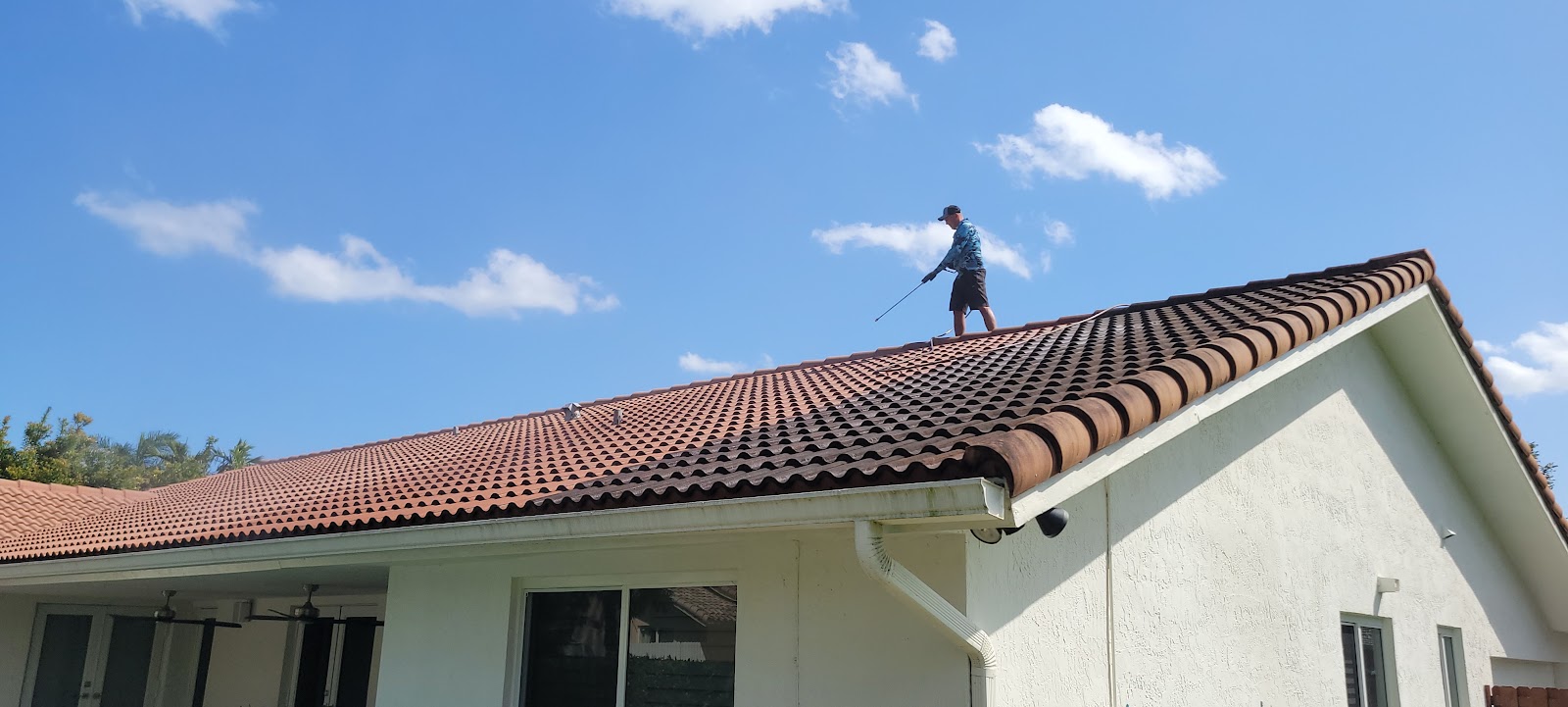
Behind all of it are the same local realities we work in every day. Those black streaks on the barrel-tile and clay roofs are Gloeocapsa magma, a cyanobacteria feeding on the limestone filler in the tile — soft wash territory only, because high pressure strips granules and voids the warranty. White haze on a stone deck is usually efflorescence, which has to be treated before any resealing or it comes right back through the sealer. And Miami runs the hardest water among major Florida cities, roughly 11 grains per gallon off the limestone Biscayne Aquifer, so sprinkler overspray leaves calcium and magnesium spots on glass, coping, and screens that a normal wash won't touch and that need a proper mineral treatment to remove.
Whether it's a restored Mediterranean home in the historic district or a bayfront estate past the second gate, we match the method to the material and give you a straight answer on scope. Send a few photos or call Moppey at +1 877-754-5614 for a free quote — most are answered the same day. No damage, no streaks, no shortcuts.