
Local guide
Exterior cleaning in Upper East Side: the complete guide
Cleaning the Upper East Side, block by block
The Upper East Side isn't one uniform neighborhood — it's a stack of distinct pockets running east off Biscayne Boulevard down to the water, and each one asks for something different from an exterior cleaner. Up on the boulevard you have the MiMo-on-BiBo commercial strip: restored motels-turned-boutique-hotels, low-slung offices, and storefronts between roughly 50th and 77th. Step east and you drop into the residential grid — Palm Grove and the Bayside blocks first, then the gated enclaves of Morningside, Bay Point, Belle Meade, and the tight lots of Buena Vista bleeding in from the west. The homes shift as you go: 1920s and '30s Mediterranean Revival and Frame Vernacular cottages, then the flat-roofed Miami Modern houses that give the district its name, then contemporary rebuilds with travertine and glass on the waterfront lots.
That variety is the whole point. On a single street here you can find an original clay barrel-tile roof, a flat MiMo membrane roof, decorative breeze-block, jalousie windows, terrazzo entries, and a modern floor-to-ceiling glass elevation — five surfaces, five methods. Anyone who shows up with one pressure setting for the whole property is going to damage something. We clean this district the way it's actually built.
The MiMo roof problem is not the same as a barrel-tile roof problem
Most Miami roof-cleaning advice assumes a pitched tile or shingle roof. A lot of the Upper East Side doesn't have one. The signature MiMo house has a flat or very low-slope roof — often a built-up, modified-bitumen, or single-ply membrane — and those behave differently. Water doesn't run off fast, so the surface stays wet longer and grows more. The black streaking and dark blotching is Gloeocapsa magma, the same cyanobacteria feeding on limestone filler you see on shingles, but on a low-slope roof it sits in standing moisture and spreads.
You cannot fix that with pressure. On a membrane roof, high pressure tears seams and drives water into the assembly; on the aged clay barrel tile of the Mediterranean houses, it cracks tiles and voids the warranty. Both get the same answer from us: a low-pressure soft wash that kills the organism at the root and lets it rinse away. On flat roofs we're also careful about where the water goes, because a low-slope roof pools — we don't want cleaning runoff sitting on the membrane or backing up at the scuppers.
Salt, sun, and the six-to-eight-week glass reality
The closer a property sits to Biscayne Bay, the harder the coastal environment hits it. Miami's coast is rated ISO C5-M — the most corrosive marine category — and that's not a technicality on the bayfront blocks of Morningside, Bay Point, and Belle Meade Island. Salt aerosol films glass daily, and left on the surface it etches the pane permanently. It rusts railings, gate hardware, light fixtures, dock cleats, and the metal frames of those older jalousie and awning windows. It keeps the shaded, humid elevations that never get sun growing mildew year-round.
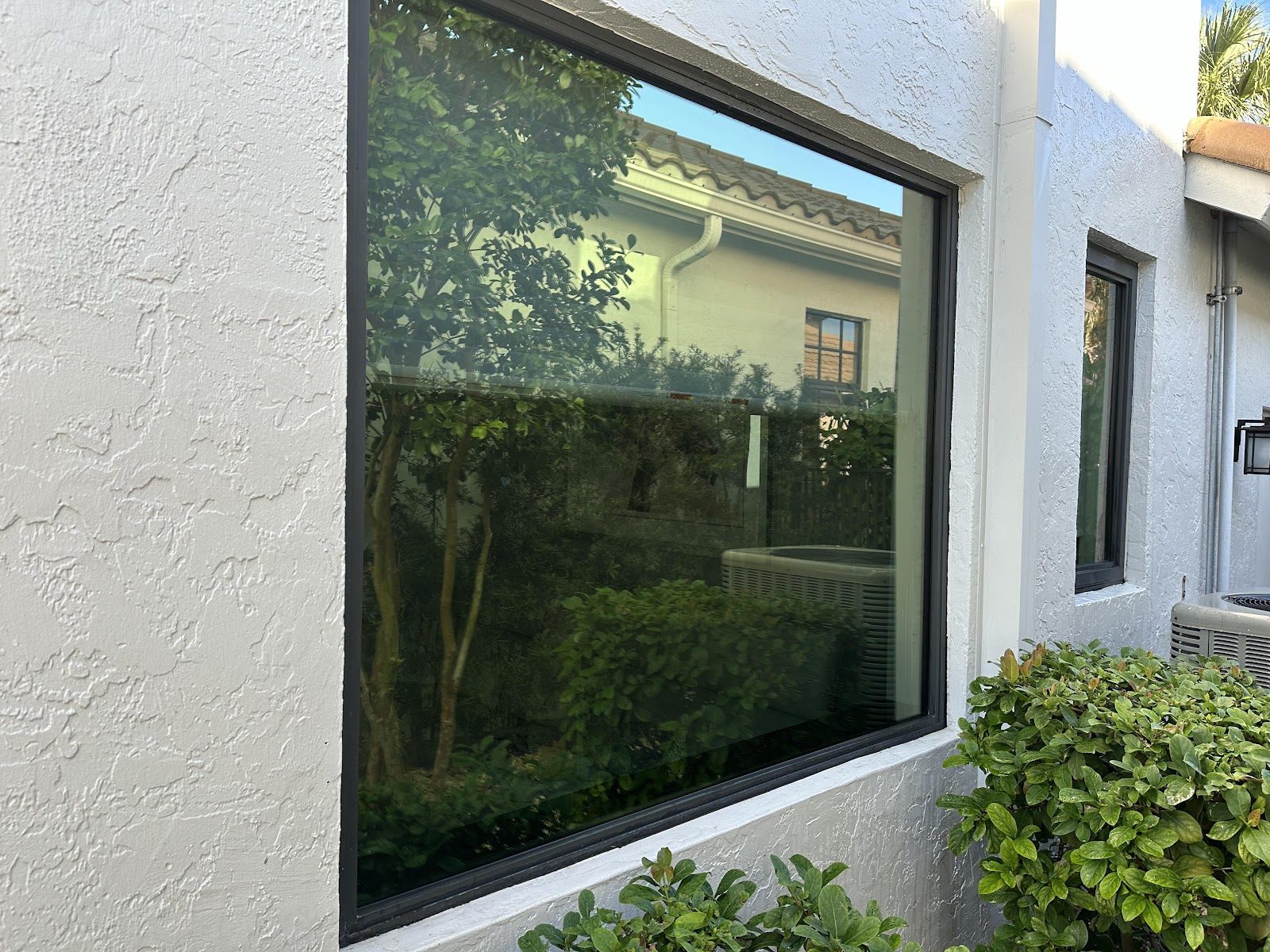
For waterfront and near-water homes, glass on a six-to-eight-week cadence is realistic if you want it to stay genuinely clear — inland Upper East Side blocks can stretch longer. And there's a second layer on top of salt: Miami runs the hardest water among major Florida cities, roughly 11 grains per gallon off the limestone Biscayne Aquifer. Sprinkler overspray leaves calcium and magnesium spots that a normal wash won't remove. On etched or spotted glass we use a proper mineral treatment, not plain water, because plain water simply won't touch it. Rust bloom on metal needs the right touch too — clean it wrong and you spread the corrosion onto adjacent stucco and glass.
The surfaces MiMo homes have that newer houses don't
A few Upper East Side surfaces trip up cleaners who mostly work newer stucco tract homes:
- Terrazzo — those poured entries and floors are beautiful and porous. Efflorescence (the white mineral haze) has to be treated before any sealing, or you seal the problem in. Aggressive pressure dulls and pits it.
- Decorative concrete block and breeze-block screens — the whole point of the pattern is texture, and texture traps algae. It needs a calibrated method that lifts growth out of the recesses rather than a wand that chips the edges.
- Jalousie and awning windows — original MiMo glass louvers and their metal frames rust and streak; the glass gets cleaned gently and the frames get salt- and rust-aware attention, not a blast that bends or floods them.
- Travertine and coquina on the newer waterfront rebuilds — soft coastal stone that pits under pressure and wants careful, low-setting cleaning.
Historic district, HOAs, and the boulevard's commercial mix
Much of this area is inside a designated historic district, and several pockets — Bay Point, Belle Meade — sit behind guard gates with HOA rules and access controls. That changes the logistics, not just the method. Period-original finishes are cleaned, not scoured; the goal is a surface that looks like it was never touched, because in a historic district "just replace it" is rarely cheap or simple. For gated and multi-unit properties we carry the liability and workers-comp coverage that access and HOA sign-off require, and we can provide a certificate of insurance on request.
Along Biscayne Boulevard the work shifts commercial: MiMo storefronts, boutique-hotel facades, awnings, and the sidewalks out front. That's gum, exhaust film, and foot-traffic grime on the walk plus salt and mildew on the facade — cleaned around operating businesses, on a schedule that respects the restored architecture. For the taller condo and mixed-use buildings creeping up the boulevard and along the bay, exterior glass and balcony work needs the right access equipment and coverage; we scope that per building rather than pretending one approach fits a two-story storefront and a mid-rise.
How often, and when
A practical Upper East Side maintenance rhythm looks like this. House washing (soft wash on stucco) once a year keeps mold and algae from getting a foothold, more often on heavily shaded or bay-facing elevations. Roof soft washing every couple of years, sooner the moment black streaking reappears — flat MiMo roofs and shaded pitched roofs stain faster. Driveways and pavers under the neighborhood's oak-and-palm canopy green up fast in the damp shade and often want cleaning yearly, with joint re-sanding as needed. Bayfront glass on that six-to-eight-week rhythm. Pool decks and stone resealed roughly every one to two years, because salt and sun break sealer down quickly here.
The seasonal anchor is hurricane season, June 1 through November 30. The smart window to get ahead of it is April and May: a clean roof sheds water the way it's supposed to, and gutters cleared of palm fronds and oak litter drain away from the foundation instead of overflowing toward it — a genuine issue on these tree-heavy lots. We treat the organic growth at the root so it stays gone longer, not just until the next rain, and we back the work with a 48-hour re-wash guarantee and before/after photos so you can see the difference.
If you own in the Upper East Side — a MiMo bungalow off the boulevard, a Mediterranean home in Morningside or Belle Meade, a bayfront rebuild, or a storefront on Biscayne — call Moppey at +1 877-754-5614 for a free quote. Send a few photos of the surfaces you need cleaned and we'll give you a straight answer on method and scope for your specific property. Hablamos Español, and most quotes are answered the same day. No damage, no streaks, no shortcuts.