
Local guide
Exterior cleaning in Flagami: the complete guide
Exterior Cleaning in Flagami: What These West Miami Blocks Actually Need
Flagami runs across three ZIP codes — 33144, 33174, and the eastern edge of 33126 — and if you drive it, the housing stock tells you exactly what kind of cleaning it needs. This is a neighborhood of owner-occupied post-war homes: single-story CBS (concrete-block-and-stucco) houses from the 1950s and 60s, terrazzo-floored bungalows, and a heavy share of duplexes and small multi-family buildings that landlords and families have maintained for decades. Add wide flat driveways, carports instead of garages, jalousie-window Florida rooms, chain-link and CBS privacy walls, and the occasional barrel-tile roof, and you have a specific set of surfaces — each one asking for a different method. That is the whole game here: the right method for the surface, not one pressure wand aimed at everything.
Below is the deeper, block-level playbook for Flagami — the things a homeowner here actually needs to know before booking, and the maintenance rhythm that keeps an inland Miami property looking clean instead of chasing stains after they spread.
House Washing: How Often Flagami Stucco Really Needs It
The standard advice for Miami is a full house wash every two years. In Flagami, most homes need it closer to every 12 to 18 months, and here is why. The neighborhood sits inland against the Tamiami Canal and the Blue Lagoon, its lots are tight, and its mature tree canopy holds shade and moisture against the walls long after the rain stops. Damp shaded stucco is exactly what algae and mildew want. The north and canal-facing elevations green up first, then the growth works its way around.
The correct treatment on CBS-and-stucco is a soft wash — a low-pressure application (well under 500 PSI) of a plant-safe hypochlorite solution that kills the growth at the root, followed by a clean rinse. High pressure on stucco is a mistake you only make once: it etches and pits the finish permanently and can drive water behind it. A soft wash does not just knock the green loose to regrow in a month; it kills it, so the wall stays clean far longer. We come plant-safe, pre-wet and rinse your landscaping, and back the work with a 48-hour re-wash guarantee.
Driveways, Carports, and the Efflorescence Nobody Warns You About
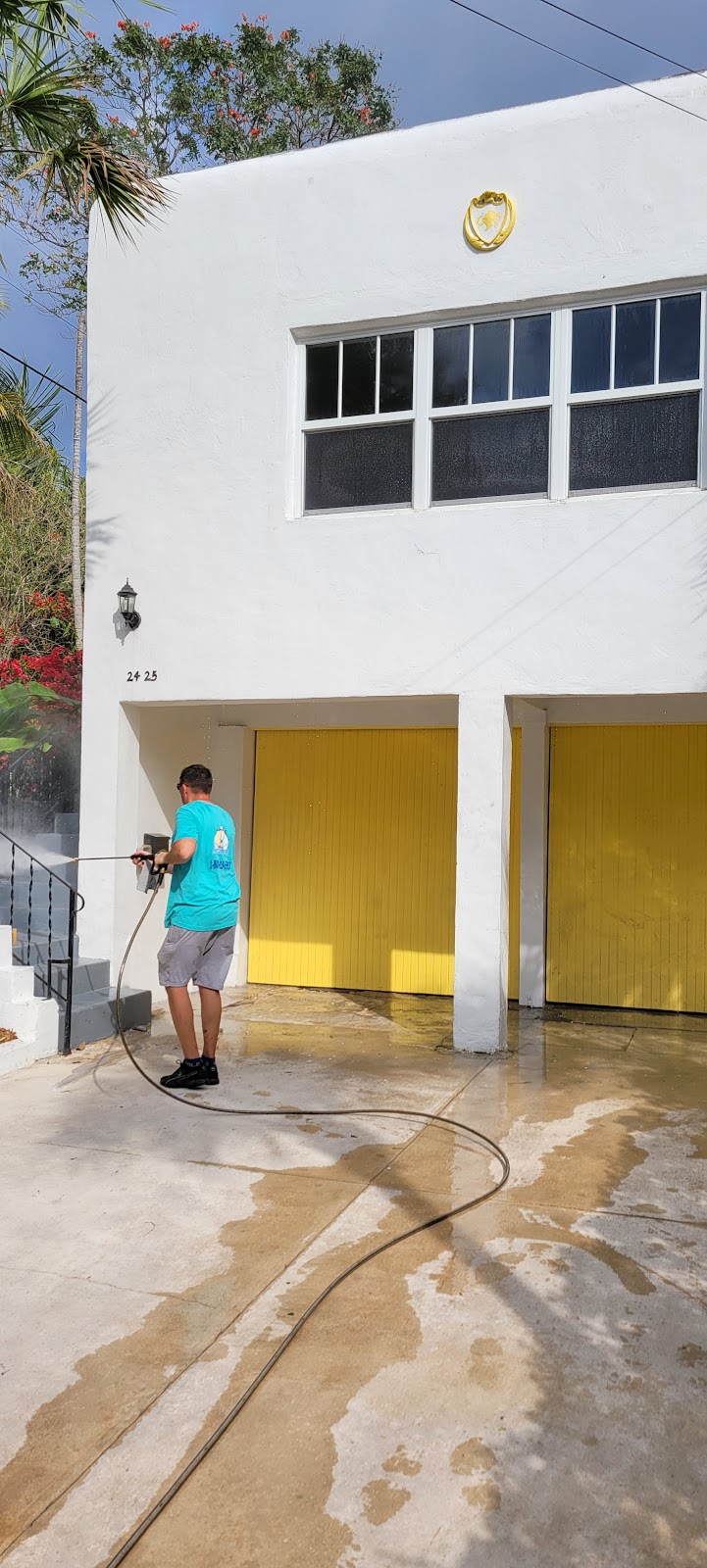
Flagami's wide flat driveways and covered carport slabs are workhorses — they collect motor oil, rust from old irrigation fittings, tire marks, and the gray-green biofilm humidity grows on bare concrete. A surface cleaner lifts all of that evenly, so the slab comes back a uniform clean instead of the wand-streaked "zebra" look. Concrete can take real pressure; the stucco wall two feet away cannot, which is why we switch methods mid-job.
If your driveway or walkway is pavers, there is a second issue: efflorescence, the white chalky haze that blooms up through pavers and CBS walls as moisture pulls mineral salts to the surface. It is common on Flagami's older paver aprons and block walls. Efflorescence is not dirt and it will not simply wash off — it has to be treated correctly, and critically, it must be dealt with before any sealing. Seal over efflorescence and you lock the haze in permanently. When we clean pavers we also protect the joint sand instead of blasting it out, so the surface stays stable underfoot.
Windows and Miami's Hardest Water
Miami draws from the limestone Biscayne Aquifer and runs the hardest water among major Florida cities — roughly 11 grains per gallon. On Flagami homes that shows up as chalky mineral spotting on glass, screens, and frames, mostly from sprinkler overspray hitting the windows every morning. Those deposits are baked-on minerals; a squeegee and a bucket smear them, they do not remove them. Proper glass work treats the mineral film rather than just wiping it, and it is worth resetting the sprinkler heads so they stop painting the same panes daily. Being inland, Flagami glass is spared the aggressive coastal-salt etching that oceanfront Miami sees, so windows here hold a clean finish longer between visits — a real advantage of the location.
Screened Rooms, Pool Cages, Fences, and Privacy Walls
Two things define Flagami backyards: screened Florida rooms and CBS privacy walls. Both stay shaded and damp, and both grow algae year-round. Screen enclosures and pool cages need a light, calibrated wash — enough to clear the frame and mesh without stressing the panels. If the pool deck is travertine, remember it is a soft stone that pits under aggressive pressure, so it gets a gentler, calibrated setting, never one blunt high-PSI pass.
CBS and painted privacy walls, chain-link runs, and vinyl fencing all green up on the shaded side and take a soft wash the same way the house does. Awnings and carport covers — common shade features here — are cleaned gently so the fabric or metal is not damaged. The goal across all of it is the same: kill the growth, protect the surface, and leave it safe to touch and walk on.
Roofs: Flat, Low-Slope, and Barrel Tile
Flagami roofs run the gamut — flat and low-slope built-up roofs on the older bungalows, asphalt shingle on the mid-century homes, and barrel tile on the dressier ones. The long black stains you see running down them are Gloeocapsa magma, a cyanobacteria feeding on the limestone filler in shingles, and it spreads across a whole roofline if left alone. On low-slope roofs that hold moisture, it takes hold fast. Every roof type here gets the same answer: a soft wash at low pressure with a treatment that kills the organism, never a pressure blast. Pressure strips the protective granules off shingles, can crack or dislodge tile, and voids most roof warranties. No damage, no streaks, no shortcuts.
Duplexes, Rentals, and Small Commercial Along Flagler
Flagami is not only single-family. It carries a large share of duplexes and small multi-family buildings, plus the storefronts, mini-plazas, and small offices strung along Flagler Street and Coral Way. Rental and HOA-managed properties need clean, presentable exteriors on a predictable schedule, and commercial curb appeal along the Flagler corridor is a direct pitch to walk-in customers. We handle building faces, walkways, sidewalks, and storefront glass on a recurring-maintenance plan a property owner or manager can actually budget around — with a certificate of insurance on request. Recurring plans also cost less per visit than letting stains set for two years and paying to fight them once they have spread.
The Hurricane-Season Timing That Matters Here
Hurricane season runs June 1 through November 30, and the smart window to get your exterior ready is April to May. Two Flagami-specific reasons: first, the neighborhood's mature and palm-heavy tree cover drops fronds and leaf debris into gutters quickly, and a clogged gutter overflows straight toward the foundation during a storm — clearing it beforehand keeps water moving away from the house. Second, a clean roof sheds water the way it is designed to; a stained, biofilm-covered low-slope roof holds it. Because Flagami's inland humidity grows algae and mildew year-round, any month is a fine time to knock growth back before it spreads — but pre-season is when it pays off most.
Get a Free Quote for Your Flagami Property
Whether it is a 1950s CBS bungalow off Flagler, a duplex you rent out, a paver driveway blooming with efflorescence, or a storefront on Coral Way, Moppey Spottless Clean Pros matches the method to the surface and stands behind it — insured, plant-safe, backed by 43 real Google reviews, and Hablamos Español. Send a few photos through our quote form or call +1 877-754-5614 for a free quote, most answered the same day.