
Local guide
Exterior cleaning in West Flagler: the complete guide
Cleaning a West Flagler home the way it's actually built
West Flagler is old, dense, and lived-in. This was once the western edge of Little Havana, and the neighborhood still carries that Cuban and Hispanic character in its streets, its corner bodegas, and its housing. What that history means for exterior cleaning is a housing stock that has been standing through Miami summers for fifty, sixty, seventy years — and a lot of it has been added onto, subdivided, or converted along the way. You'll find the postwar CBS ranch on one lot and, right next door, an older single-family home cut into a duplex or a fourplex, or an apartment carved out of what used to be one family's house. Those conversions matter, because they mean more units sharing one roof, more shaded exterior walls hemmed in by additions, and driveways and walkways that carry twice the traffic they were built for. A one-size wand does not work on a street like this. The right method for each surface is the whole job.
The surfaces that define this neighborhood
West Flagler's density is its signature, and density is what dictates the work. Here is how it breaks down by surface — and why each one needs a different approach.
- Painted stucco on CBS walls. Almost every home here is concrete block finished in stucco and painted. Between closely spaced houses, the north and side walls stay shaded and damp, and that's where mildew and algae take hold as green and black film. Painted stucco cannot take high pressure — it drives water behind the paint and blows the finish off in patches. It gets a soft wash under 500 PSI with a plant-safe cleaning solution that kills the growth at the root, so it doesn't just gray back in a month.
- Flat and low-slope roofs. The postwar homes here favor low-slope and flat roofs, which hold moisture and streak black faster than a steep pitch ever would. Those streaks are Gloeocapsa magma, a cyanobacteria that feeds on the limestone in the shingles. High pressure strips the granules and voids the shingle warranty, so it never belongs on a roof. Soft washing clears it and keeps it clear.
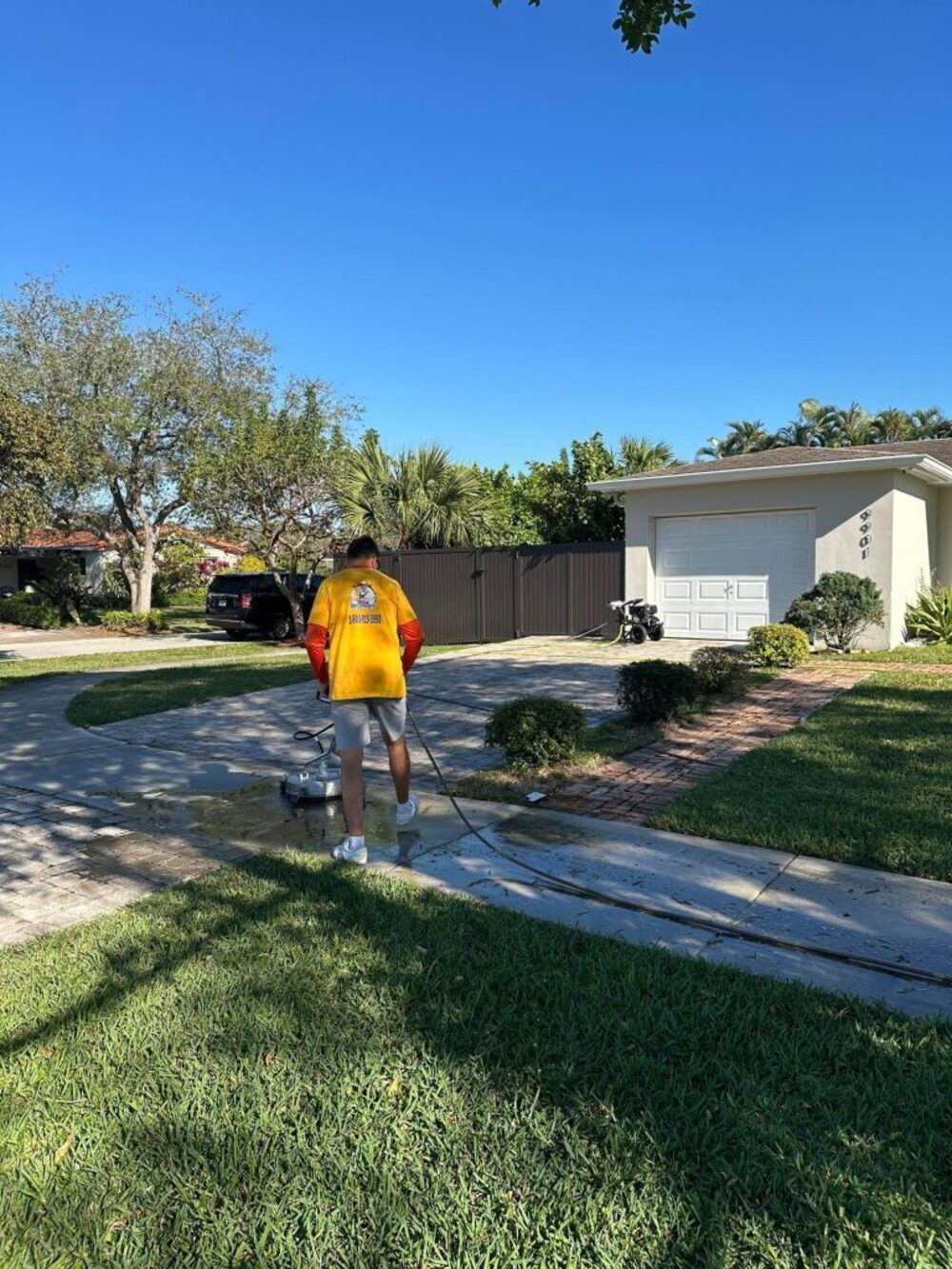
- Concrete driveways, carport slabs, and public sidewalks. These take real, controlled pressure — but with a flat surface cleaner, not a spinning wand, so you get an even clean with no zebra-stripe wand marks. On a West Flagler block the driveway usually runs right up to the front door and shares an edge with the neighbor's, so the line between "your slab" and "theirs" gets cleaned cleanly.
- Pavers. Popular for driveway aprons and back patios here. Pavers get soft-to-moderate pressure and, where the joints have washed out, re-sanding after cleaning so weeds and ants don't move back in.
- Iron gates, fences, and window bars. Wrought-iron front gates, security bars, and fences are everywhere in West Flagler — a defining look. Salt-laden Miami air rusts them, and rust bleeds orange stains down the stucco below. We clean the metal and treat the rust bleed off the wall rather than leaving the stain to reappear.
- Screen enclosures and carports. Screened patios and carport structures collect a fine green haze in the humidity. They get a low-pressure rinse calibrated so the mesh and framing aren't torn or bent.
- Windows and Flagler Street glass. Residential windows here haze with mineral spotting; storefront glass along Flagler collects road film and cooking grease.
The white haze problem — efflorescence, not dirt
On older painted-block homes and on paver and concrete surfaces around West Flagler, you'll sometimes see a chalky white bloom that no amount of scrubbing removes. That is usually efflorescence — mineral salts pushed to the surface as moisture wicks through the block, extremely common in Miami's older CBS construction. It is not mildew and it does not respond to a normal wash. It has to be treated specifically, and — this matters if you're about to reseal a paver driveway — it has to be dealt with before any sealer goes down, or you trap the haze under the coating permanently. If you've been fighting a white film that keeps coming back, that's the fix, and it's worth flagging when you request a quote.
Miami's hardest water leaves its mark
Miami draws from the Biscayne Aquifer and runs the hardest tap water of any major Florida city — around 11 grains per gallon. In West Flagler that shows up as stubborn mineral spotting on windows, glass doors, and any surface the sprinklers hit, plus scale where a hose or irrigation line drips. Rinsing a window with that same hard water and letting it air-dry just re-deposits the minerals. Getting glass genuinely clear here takes technique, not just a squeegee and tap water. It's a small detail that separates a real exterior wash from a quick rinse.
Inland address, coastal air
West Flagler sits inland — you're not on the bay — so the primary enemy is humidity, not the constant salt spray that hammers Miami Beach or Brickell. That's why the biggest recurring problems here are mildew on shaded stucco, black-streaking roofs, and algae on concrete: moisture that never fully leaves. But West Flagler is still Miami, and salt-carrying air reaches these blocks enough to rust the wrought iron and speckle glass over time. So the plan is humidity-first — soft washing the organic growth off stucco and roofs — with attention to the salt-driven rust on all that ironwork the neighborhood is known for.
Duplex, fourplex, and small-multifamily owners
A lot of West Flagler is owner-occupied on one side and rented on the other, or held as a small income property. If you own a duplex, a fourplex, or a converted multifamily, the exterior is doing double duty — it's your home and your product. Curb appeal is what a prospective tenant sees first, and a mildewed wall or a black-streaked roof reads as deferred maintenance before anyone walks inside. We handle these the same careful way as a single-family home, one surface at a time, and can set up a recurring schedule so the property stays rent-ready without you having to think about it. We're fully insured and can provide a certificate of insurance on request — useful if a property manager or lender asks.
The Flagler Street storefronts
The retail spine that gives the neighborhood its name is a working commercial corridor — restaurants, markets, shops, and services with heavy foot and drive-by traffic. Sidewalks collect gum and grease, entry walkways darken, awnings gray out, and facades pick up road film and exhaust. A tired-looking entrance costs a business the walk-in before anyone reads the sign. Hot-water commercial cleaning lifts grease off concrete and pavers without gouging them, and we schedule around business hours so the storefront is bright when the doors open. One-time cleans and recurring maintenance plans are both available.
When to book in West Flagler
For most homes here, once a year keeps the stucco, driveway, and walkways ahead of the mold and algae that Miami humidity feeds — and the shaded walls between closely built houses may want it a touch sooner. Flagler Street storefronts usually need it more often because of foot traffic and road film. The smartest window to book residential work is April or May, before hurricane season runs June 1 to November 30. A clean roof sheds storm water instead of holding it, and clear gutters — the ones that fill with palm fronds and debris around here — carry runoff away from the foundation instead of overflowing against it. Going into storm season clean is cheap insurance.
Every job comes with our standard promises: plant-safe soft-wash chemistry, before-and-after photos, and a 48-hour re-wash guarantee if anything doesn't come up right. No damage, no streaks, no shortcuts — and no invented prices. We give you a free quote based on your actual surfaces.
Ready to see your West Flagler home or storefront cleaned the right way? Call Moppey Spottless Clean Pros at +1 877-754-5614 for a free quote — most are answered the same day. Hablamos Español.