Local guide
Exterior cleaning in Shenandoah: the complete guide
Cleaning a century-old neighborhood the way a century-old neighborhood needs
Shenandoah is older than almost anything around it. Platted in 1919 by developers who borrowed the name from Virginia, it grew up in the 1920s building boom as one of Miami's original streetcar suburbs, and the housing stock still tells that story block by block. What that means for exterior cleaning is simple and important: the surfaces here are not the poured-concrete, hurricane-code, big-box materials of a 2010s subdivision. They are older, softer, and more particular, and the wrong crew with the wrong wand can cost you a repair on something that isn't easy to replace.
We work these numbered streets — roughly SW 8th Street down to Coral Way, west of The Roads — often enough to know which surfaces forgive pressure and which never will. This guide goes past the basics on the rest of the page and gets into what actually keeps a Shenandoah exterior looking cared for without doing it any harm.
The materials under the paint matter more here
Drive the interior blocks and you'll see it: Mediterranean Revival and Mission-style bungalows, arched porches, stucco over hollow clay tile and concrete block, and barrel-tile roofs that have been up there for the better part of a century. Scattered through the neighborhood are the native-rock houses Shenandoah is known for — oolitic limestone and coral rock façades, sometimes whole walls of it, quarried locally and laid up by hand in the '20s. Some homes still carry Dade County pine framing and the ornate ironwork on porches, gates, and window grilles that dates the block.
Each of those materials wants a different hand:
- Oolitic limestone and coral rock is porous and mineral-soft. It stains green and gray in the shade and it holds that grime deep in the pores, but it will pit and lose face if you hit it with a turbo nozzle. It's a soft-wash surface — solution first, low pressure to rinse, never a blast.
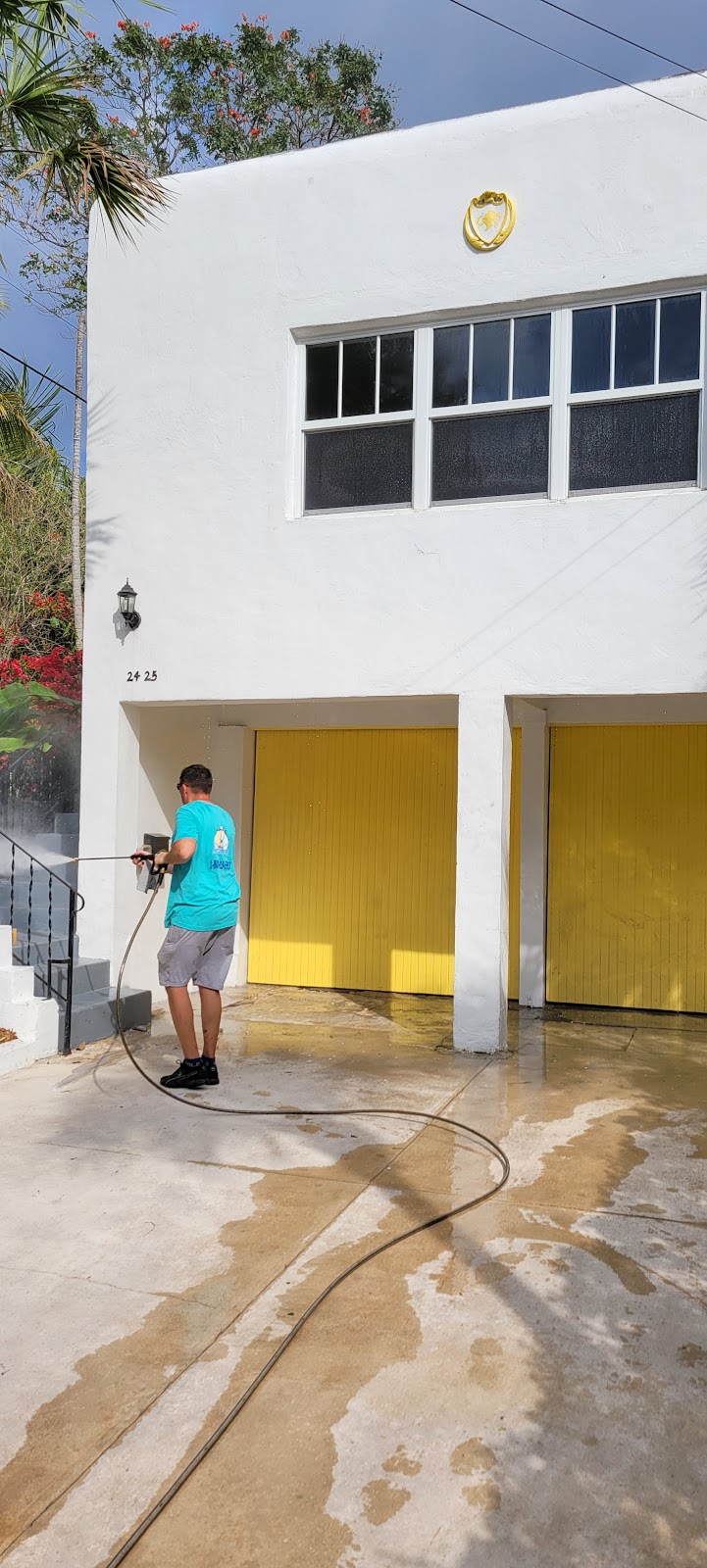
- Original 1920s stucco over clay tile or block etches and chalks under high pressure, and pressure can drive water behind a wall that was never meant to be pressure-sealed. Under 500 PSI with the right hypochlorite dilution, the mold and algae come off and the wall stays intact.
- Barrel tile cracks and sheds its surface when it's old, so the black streaks (that's Gloeocapsa magma cyanobacteria feeding on the limestone in the tile) come off with a low-pressure soft wash, not a walk-on pressure blast that voids what warranty the roof has left.
- Ornate iron rusts and bleeds onto stucco below it. We clean it and treat the rust film without spotting the metal or accelerating corrosion.
Shade is the real enemy in Shenandoah, not salt
This is inland Miami, so the coastal salt problem that hammers Brickell and the Beach barely registers here. What you have instead is a mature oak and ficus canopy — one of the neighborhood's best features and, for your exterior, its most persistent challenge. That canopy keeps north- and east-facing walls, porches, driveways, and walkways from ever fully drying between Miami's near-daily summer rains. Damp plus warmth plus organic leaf litter is the exact recipe algae and mildew want, and it's why the shaded elevation of a Shenandoah house greens up months before the sunny side.
Two practical consequences follow. First, the shaded surfaces come back faster after a wash than they would in full sun, which is why a recurring soft-wash schedule makes more sense here than a once-and-done clean — we treat the growth at the root so it stays gone longer, and a light annual or twice-yearly pass on the shaded walls keeps you ahead of it. Second, the front sidewalk and driveway under the canopy pick up a gray biofilm and tannin staining from the leaves that a garden hose will never touch; a flat surface cleaner at the correct pressure lifts it evenly with no wand striping.
White haze, mineral bloom, and Miami's hard water
Two problems show up on Shenandoah masonry that homeowners often misread as dirt. Efflorescence — the chalky white bloom that appears on stucco, block, and especially on those coral-rock and limestone walls — is mineral salt migrating out of the masonry, not surface grime. It has to be treated correctly, and if you're planning to seal a driveway, patio, or stone wall, the efflorescence gets dealt with before the sealer goes down, not trapped under it.
The second is water spotting on glass. Miami has the hardest tap water of any major Florida city — roughly 11 grains per gallon off the Biscayne Aquifer — so an ordinary hose rinse dries to mineral spots on windows and glass railings. We finish exterior glass so it dries clear, which matters on the original divided-light and arched windows a lot of these homes still have.
Historic-district care and the new builds mixing in
Much of Shenandoah sits inside or beside recognized historic survey areas, and owners here tend to be restoring, not renovating away. That fits how we work: gentle, surface-appropriate cleaning that gets a façade camera-ready for a repaint, a real-estate listing, or just the pride of a well-kept block. If you're repainting original stucco, a proper soft wash first strips the algae and chalk so the new coat actually bonds — a step careful painters ask for and quick ones skip.
At the same time, Shenandoah is changing. Infill construction and modern rebuilds are appearing between the bungalows — smooth stucco boxes, standing-seam metal roofs, large glass, poured driveways and travertine or paver decks. Those newer surfaces have their own rules: travertine is soft and etches, so it's a low-pressure clean; paver joints lose their sand if you blast them, so we clean without stripping the joints and re-sand on request. Whether your lot holds a 1924 coral-rock bungalow or a 2022 rebuild, the principle is the same — the method matches the material.
Driveways, walkways, and the city sidewalk out front
Shenandoah's single-family lots came with generous driveways, and a century of use plus canopy shade means they collect oil, tire marks, rust bloom from irrigation and iron, and that stubborn organic film. We lift it with the correct pressure and a surface cleaner for an even finish — no gouging on old concrete, no zebra striping. The public sidewalks along the numbered streets are their own job: gum, grime, gray biofilm, and leaf tannin, brought back flat and even. Restoring the front walk and driveway does more for curb appeal here than almost anything else, because on these tree-lined blocks the hardscape is the first thing a visitor's eye lands on.
Timing it to Miami's calendar
The single most useful piece of timing for a Shenandoah homeowner is the pre-hurricane window in April and May. Storm season runs June 1 through November 30, and on a lot with heavy canopy your gutters fill with oak litter and palm fronds fast — a clogged gutter overflows toward the foundation of an older home instead of carrying water away. A clean roof sheds water the way it's designed to, and clear gutters keep it moving off the property. Getting the roof soft-washed and the gutters cleared before June is cheap insurance on a home that's already stood through a lot of storms.
Working with Moppey in Shenandoah
We handle both the historic single-family homes and the smaller commercial exteriors along the SW 8th Street and Coral Way edges — storefronts, walkways, and building faces. We're fully insured with a certificate of insurance available on request, our soft-wash chemistry is plant-safe and we protect and rinse landscaping as we go, and we back the work with a 48-hour re-wash guarantee: spot-free and streak-free, or we make it right. Forty-three real Google reviews from across Miami-Dade, and hablamos español.
If you own a home or manage a property in Shenandoah, send a few photos or call for a free quote — most are answered the same day. Reach Moppey at +1 877-754-5614 and we'll recommend the right method for your surfaces, no damage, no streaks, no shortcuts.